Thursday, 27 October 2022

Licence Story 1 - Getting a Driving Licence in India

Post-retirement, arriving in Doha, I began an effort to obtain a Qatari driving licence. Not an easy task. 

I recall those driving schools found in every small township of Keralam or India. With a small office space, and one or two vehicles, usually old and not otherwise usable.  I remember, the Malayalam movie character of actor Innocent as a driving school 'proprietor' (that used to be the term used for the owner cum trainer of a typical driving school) in Chennai in the popular movie 'yaathrakkarute sraddhakku'. 

I never went to any such school to obtain my licence(s).  As a seminarian, I sought permission from our Provincial, Rev. Fr. Mathias of happy memory to get a driving licence, and he readily gave consent.  It never occurred to me that I should try to get some training or should get a four wheeler (LMV) licence as well. With the initial introduction to riding a two wheeler by Rev. Fr. Zacharias CMI in Kalagarh, Bijnor district, I decided to go after getting that precious entitlement.  I was placed with him for a kind of a 'correctional home' sentence by our then regional superior, Rev. Fr. Mathew.  But he was really happy with me, and when it was time for the 'correctional term' to be shifted to Keralam, he insisted that I accept some present from him - a present of my choice. On being insisted upon, I asked an unexpected gift from him, that I be given some basic training in riding a scootter.  He obliged and I had gained some idea as to how to ride a scooter in the open space of  the sleepy Kalagarh township, at the foothills of Himalayas. But didn't have any proper training, nor confidence.  At Kalamassery, where I spent the rest of the year of the 'correctional term' whenever possible, I made use of the opportunity to help the school headmaster (Rev. Jose Kariamadam, a good senior friend in the congregation) to get his scootter 'refuelled' as a means to enhance my driving skills. Initially, I was not able to kick-start the bajaj scooter properly; I used to ride it down the steep slope, and shift it into the gear to have it started. 

I went to the district collectorate (Kakkanadu) and went through some process through which I was given a learner's licence (for a period of 6 months). I think there was some sort of a test or interview. I vaguely recall a crudely printed pamphlet with some rules and signals on it.  The good part of all this was this: with that in hand, you could really drive around, if you got a vehicle - yes, the rule stipulated that you should have an 'L' board, and also someone with proper licence accompanying you.   But this was hardly ever adhered to in those days. 

This was in the year 1989. The new road regulations applicable all over the country had been just introduced. There was change in the style of numbering. Hand Signals were drastically altered.  Almost like performing some sacred rituals, but evidently aimed at greater safety on the roads. Things were being made more systematic and standardised. The licence of any state would be valid for riding anywhere in India. 

I had to go back to Najibabad, UP and the validity period of my learner's licence was nearing the end.  It was not a great concern for me.  However, it so happened then that I got the invite to attend my brother's wedding.  Usually, we are not permitted to attend such functions.  I do not know why and how, but the new superior, Rev. Fr Augustine was gracious enough to permit me to attend the function.  I was more thrilled at the prospects of attending a driving test within the validity period, as the wedding day and the date of expiry of learner's licence apparently coincided.  I reached a day or two ahead of the wedding, and sought the source from which I could get a two wheeler for the test.  Somehow, I came to know Rev. Fr. Kuriedath, whom I had known as a school boy, and who was now a faculty member at Sacred Heart College, had a scooter under his custody, and I took the courage to ask him the favour of using it for the test.  And he agreed readily. So, on the day before the wedding (I guess so), I collected the scootter and went to Eroor, near Thrippunithura, where an open space (most likely, a purampokku) was being used by the Vehicle Inspector for the test.  Prior to that, in the morning, I had made some trials of negotiating an '8' with the scootter.  I felt okay.  I could do it. 

There were quite a few and we had to register there for the test. No prior appointment was required in those days, only that you had to have a valid learner's licence (LL). I was tipped-off by an onlooker (or a local person) that I was supposed to have a helmet on, while undergoing test. Those days, it was hardly fashionable or mandatory to have a helmet.  So most of the people had come without it, unless instructed by a trainer.  Then the 'friendly neighbour' volunteered to help me with a helmet from somebody, who was willing to spare the same for a 'token amount' of Rs. 100.00.  (it was indeed a big amount for those times.  One litre petrol cost just about Rs 6). I agreed.  It was also fortunate that since I was travelling, I had some money.  Otherwise, to have Rs 100 readily with oneself was less likely, especially for a seminarian.  I didn't even have a wallet, the money if any, was kept in the pocket of shirt or trousers. 

Then came the test - I think there were more than 10 candidates.  The main items of the test were (i) signals while riding and (ii) the fatal 8 ride.  Some sticks are kept as boundaries of the track of 8, and you were supposed to do the ride without stopping and without having any of those sticks hit. Even a light brushing against it, would bring the stick down, which implies failure. I rode very slowly carefully and managed to scrape through.  I noticed that just 2 of us managed to do that. The test was cleared! (Here is the crucial role of driving schools, where the candidates get through even without 8 - thus I am told! The fee includes amount for greasing the palms of the vehicle inspectors as well!)

I have forgotten when and how I got that small pocket book called licence! I think someone received it on my behalf or it came by registered post!! Any how, I was a licence holder by 1990 September and without having to undergo a driving school training, nor having to bribe anyone. I thought it was no mean achievement. 

On arriving back in Najibabad, and finding my juniors trained in a mission seminary all equipped with driving license, and being placed with the Bishop's house as in-charge of a library cum cultural centre, I felt it would be good to upgrade myself with the skill of driving a four wheeler. The beloved bishop Gratian had no hesitation in granting the permission, while reminding that possession of a licence doesn't mean that you would become dependent on having a four wheeler - this has stayed with me till now.  The process repeated - an interview for LL with the RTO, just across the boundary of the bishop's house. My trainer was Mr. Blassius, our domestic support staff turned into driver. I was teaching him Hindi alphabets, and he was teaching me driving.  I remember his tips regarding release of clutch, night riding ettiquetts.  It was a 3-gear Mahindra jeep.  I went for the test, fearing likelihood of a coercion for bribe. I went equipped with a pocket tape recorder.  The RTO who had, by now become familiar to me, and who knew our institution very well, got into the front seat - asked me to drive.  I drove.  We drove along the high way, and he asked me stop at an incline as were climbing.  I stopped, and with the technique taught by Mr. Blassius of managing brake and accelerator simultaneously, I managed that without the vehicle slipping back.  That was it.  I had cleared the crucial test!

The RTO asked me to give a donation to the cause of their association.  Though it was coercion, I felt this was comparatively a better bargain, and in the strict sense, not a bribe - a good will gesture (under constraints).  I think I paid Rs. 100 or 200. Got a receipt for the same.  Something was recorded - it was not very clear and the issue was not that grievous as to warrant an action. 

The formalities took almost 3 months or more.  A memo was sent to Ernakulam RTO asking if there was any objection.  The RTO said that if they did not receive any objection %within 3 months, the licence will be stamped on my existing Kerala licence.  After 3 months or more, while I was already a student of Theology in Dharmaram College, my stamped licence came by registered post! I had authorised, my junior in seminary, now Rev. Dr. Sebastian Payyappilly, who had received it, and sent it to me. What an achievement!  It took me almost 5 more years, before I could actually drive a four wheeler using my 5 year old licence! I had lost all touch.  Rev. Bp Kariyil, my boss of those times, encouraged me and advised that I get tsome raining at the local driving school at Kalamassery, owned by the one and only Berly ashan of Matha Motor Driving School, Kalamassery,  before I ventured to use the institutional vehicle at Rajagiri College. I did that, and was further guided by the college admin staff, Mr. Jolly, using the ambassador KRH 1081, fitted with a matador engine, and having a platform gear! Otherwise, ambassadors had the gear around the steering wheel, those days!  I learn that Berly chettan is no more - departed about three months ago! May he rest with the Lord! 

(I was also caught for 'drunken driving' in  that vehicle, for having provoked the police on the  MG road, that in spite of their horn and flashing lights, I had not given them way to overtake and go ahead.  To my limited skills, there was no space to let them pass by.  I had stretched out my signalling hand, and raised it as if asking a question, which they interpreted as 'slow down signal' shown to a police vehicle! But did they manage to overtake.  Force me stop, and sensing that there was some alcoholic intake, took me straight to the police station and immediately to the government hospital.  But I clearly saw the test result indicating below the limits.  We were let off, and asked to come and collect the vehicle the next day and pay the penalty.  Mr. Jolly did that, and fell into a depression feeling that he was responsible for this incident, though he was no where in the picture.  I checked with the advocate and he said that if I was confident of the result, it was better to fight the case, than plead guilty.  It took more than  2 years for the matter to be heard - there was always the tension of what would happen remaining. But once it came to the court, the judge saw the result, and the case was quashed.  I was cleared of a violation on record - though the process kept me tensed for more than two years, and instead of the penalty of Rs.500, ended up paying the advocate a nominal fee of Rs. 2500.00.)

I was instrumental in selling that off to Koonammavu ITI and assisting my boss in getting a modern car for the college - a TATA Indica!

I have had rides to Idukki, to Coimbatore, to Trivandrum and even a major trip to Bombay, with four of us taking turns.  However, I have stuck to the principle indicated  by Rev Bp Gratian - almost deciding not to use four wheeler, to the extent possible, with the twin purpose of regulating my needs as well as minimmizing on the Carbon front. 

What I hold as a matter of pride is that I could achieve this without any 'formal training' and without having to use the means of bribe.  But it had its negative factors that I had never got clear instructions regarding the managing of a vehicle, and I remained poor with the skills of reversing a vehicle, though I could always 'manage'. 

Wednesday, 26 October 2022

Diwali - Celebrating the Light

Remembering those old days of Diwali.  We used to have Diwali holidays, I think for almost a month.  But that is a vague memory. Dusserrah and Diwali put together, it was a month-long break. Illumination used to be a major attraction - the streets of Meerut would be all lit up. 

I feel unfortunate that our training did not think of purposeful exposure to those cultural aspects.  What we did was perhaps, going around the streets for a night to see the illumination - that itself I am not very sure; nor do I recall to have relished it. 

There was hardly any celebration in the training house related to Diwali, whereas when we came to the major seminary, this aspect of 'inculturation' was taken into account to a greater extent. Even while staying within a UP village, we hardly had any such celebration, which I consider bad training as far as mission orientation was concerned. 

Diwali or Deepavali is literally the aavali (line or row) of deep (lights). 

The two myths behind are linked to the two most popular deities of the Hindu pantheon, two of the ten incarnations of the sustainer God, Vishnu, viz., Ram and Krishna.  The former, in connection with his glorious return to Ayodhya after the fourteen years of enforced exile and destruction of the evil as represented by Ravan of Lanka; the latter, in commemoration of his victory over the evil power Narakasur. Either way, the welcome was by lighting the lamps all along the streets. Hence the 'deepavali'.  

The rituals surrounding Deepavali spread over five days are interesting to note: 

Day 1 - Dhanteras or Dhantrayodas - a celebration of 'well-being' as linked to 'Lord Dhanwantari' of Ayurveda. He is said to have emerged during the amrt manthan with a pot of amrt (nectar). There is a practice for well-being involving a holy bath around sunset, a veneration of tulsi (Ocimum sanctum) with a diya (earthen lamp), and a prayer to the Lord Yama, to avert (his) unwelcome, untimely interference during Diwali. Dhanteras also has a connection with 'dhan' (prosperity) as symbolised by the goddess Lakshmi, who is venerated on the day.  It is considered to be the auspicious day for the purchase of gold and other precious metals, and household utensils and automobiles. The word is from the combination of 'dhan' and 'teras' - the latter referring to the thirteenth (terahvam) day of the krishna paksh (the dark fortnight) of the month of Kartik - usually falling in the months of either October or November. 

Day 2 - Narak chaturdasi, in celebration of the triumph of Lord Krishna over the ferocious demon Narakasur, who held the wicked practice of abducting the 'gopis'.  The house and premises are kept clean, and fragrant oil and flowers are used to keep the spirits lifted.  There is a practice of traditional rangoli ((design patterns) using rice flour, as a welcome symbol, with a diya kept lit in the rooms and in the backyard throughout the night. 

Day 3 - Diwali recalling the welcome given to Lord Rama on his triumphant return to Ayodhya. Rituals led by the priests, lighted houses and streets, delicious sweets and firecrackers are the components of the celebration. For many, the day is a celebration of 'prosperity' by worshipping Lakshmi, the goddess of wealth, on her birthday. Rangoli motifs indicate welcome to Lakshmi.  It is considered auspicious for the traders to open their new account book (chopda pujan).  West Bengal celebrates Maa Kali during the night. 

Day 4 - Govardhan Pujan  This is a celebration of Lord Krishna's protective intervention to save the people of Brndavan from submerging on account of Indra's wrath that took the shape of torrents.  He lifted Mt Govardhan to protect his people.  There is a huge gathering of pilgrims in Mathura during this day.  Wearing new clothes and jewellery, and distributing sweets among friends and relatives form part of the celebration. 

Day 5 - Bhai Dhooj celebrates the brother-sister relationship, after Yama and Yami.  It reminds the devotees of Yama's gladness and promise of blessings on all brothers, who visit their sisters.  It is after the incident of being received heartily by his sister Yami. A very fine sentiment indeed (I notice that Indian traditions have prominently placed days to celebrate ancestors, guru, brother, sister, and husband - but so far, I have not come across any for wife or parents.  Perhaps, I am wrong.)

However, the net effect of this beautiful religious festival in North India is turning to be adharmik, with the environment getting highly polluted on account of the mode of celebrations.  Even in 2022, the day after Diwali showed Delhi topping the list of most polluted capital cities of the world, with a level of air quality considered hazardous, much above 300. With numerous court and government orders proving to be toothless in this regard, it is for the religion to bring back the celebration to its dharmik core, and helping people to celebrate and enjoy without having to violate 'mother earth'.  

In the northern states of India, Diwali marks the onset of the winter season. People get into warm clothes from Diwali. Perhaps the cleanliness drive related to Lakshmi puja also has something to do with the onset of winter; preparing for the colder weather with the house cleansed and sanitised. The next thorough cleaning might happen only with Holi, the official mark of the end of the winter season!

In the southern state of Keralam, Deepavali is not celebrated with great festivities. Generally confined to Hindu families, and felt in the neighbourhood, by the occasional firecrackers in the evening.  These cultural details of Diwali are hardly known to people outside the Hindu fold, that too of Northern India.  I feel,  that living together in the neighbourhood with communities of diverse cultures (faith and festivities), it is important to know such details and appreciate them. 

Festival of Lights beyond Religious Borders: My interest is awakened at the thought of the 'festival of lights', with light being a very prominent symbol in all spiritual pursuits.  The believer, or rather, the seeker is led by a quest for 'enlightenment', which raises him or her above the mundane planes, to move around with the 'freedom' of a child of God! It is interesting to note that it was the Roman tradition of celebration of light that got adapted into the Christian culture as Christmas, the celebration of the birth of God's Christ (anointed) on earth as its light and life. The Greek tradition of celebrating the virgin birth of the popular indulgent god Dionysius marking December 25th as the day, or the Athenian tradition of venerating Kronos around that time, or most likely the Roman festivities around Saturnalia somewhere around December 15th and 23rd, with all sorts of freedom, are said to have been fused into and drastically transformed as a Christian festival celebrating the birth of eternal light on earth - it had less to do with the historical date of the birth of Christ. Christian Catholic traditions have elaborate celebrations of light during the Easter festivities.  This latter is celebrated more as linked to the time of the year when those events actually happened in history. 

Ideally, Christmas celebrations for Christians in India would fit rather well with the culturally fitting festival of lights - where we welcome into our homes and hearts, the Light of lights, who is also the greatest wealth for the believer.  Perhaps, now it is too late for such culturally adapted thinking, for Christmas too has taken the shape of a festival, more to do with festivities and commerce around it - cake, cards, gifts, Christmas tree - and less to do with Christ.  

On a different plane, it is a feast to celebrate the Light.  The Supreme Light leading to 'light within' - enlightenment. It is a call to be people of light; to walk in the light; to be the light. It is to be within human beings, as  'goodness' towards all! Flooding the world with the light of goodness. 

And the feast, with its various celebrations, refers to the multidimensional aspects of being whole, presenting various aspects of fullness through various deities - prosperity, health, cleanliness, knowledge and wisdom, goodness over evil, protection from evil, brotherly bonds. 

O Light of lights, Lead us to that Light!

Om tamasoma jyotirgamaya!

Diwali 2024 Sitapur,   UP. : I was surprised and glad to learn about CM Yogi's initiative to make

Diwali closer to green by introducing green fireworks' instead of the conventional ones in the city of Ayodhya - perhaps, in other places as well.  I was inspired to set a model on the campus. Got our cultural coordinator and the student council chairman to enquire.  The latter does some homework and gets back saying this could be done at an expenditure ranging between 20 to 40k. I felt my hands singed even without venturing to fire a cracker. Perhaps, next time, when the technology becomes more affordable. 

In an assembly held to celebrate Diwali, our BCA students volunteered to present a simple skit to promote a firecracker-free (green) Diwali.  A student spoke about the 'science' behind Diwali - stressing the positivity generated by the warm and pleasing light, and the cleanliness aspect of the festival. Another spoke about 'green diwali'.  As the Principal, I asked them if they could make an effort to make their celebrations as green as possible, as less polluting as possible, especially doing away with fire-crackers. 

But the Management department was the most sportive - their department club came up with the idea of a competition of toran, diya decoration and rangoli - all based on nature-friendliness. And some of the toran models were fabulous. One was made up of leaves and petals entirely  - it was very impressive for the possibility it showed. So, it was used to decorate the office door of the Principal.  The diyas were also decorated or painted using various aspects of environment friendliness - starting minimalism to the extent of R for repurposing being employed for decorating diyas.  The department did not stop at that - they initiated with the students generously consenting to have a sale of the same on the Diwali assembly and both the staff and the students were generous to purchase the entire produce with the decision that the price would be fixed by the creator and all the emoluments from the sales would be used for community outreach/service programmes.

The green agenda was taken further by SHIMT, our management institute organizing a contest 'Once

Upon a Chef' for creating food that does not require fuel for cooking - and almost 40 teams (of max 5) took part in the event, and with the contest over, the entire set was gobbled up by the ravenous crowd (which also included the contestants). I could see only its devastated post-attack state.  The contest fits well with the SDGs, especially Goal No. 2 of Zero Hunger. 

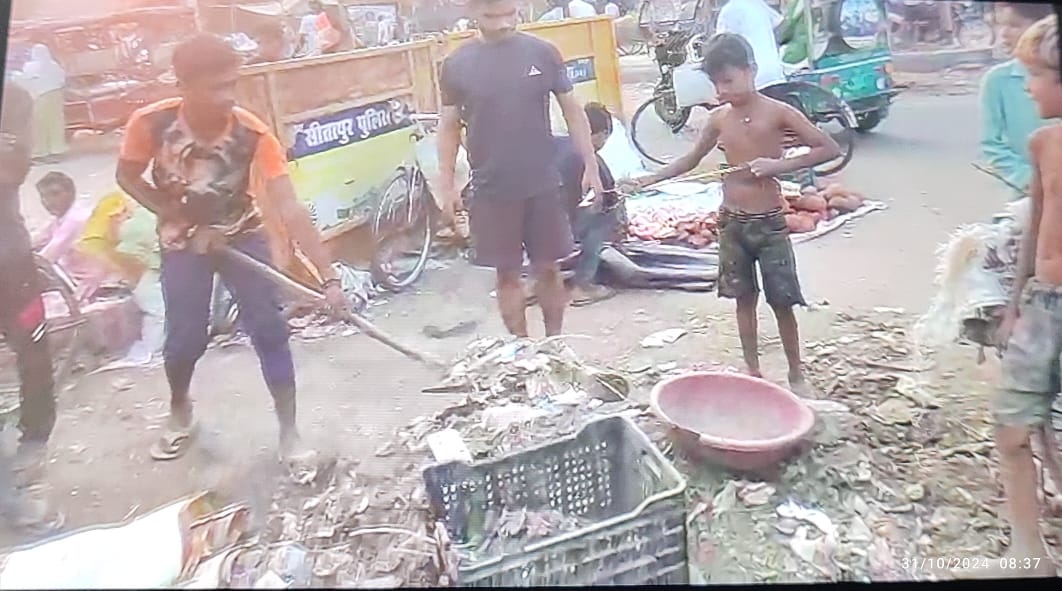
Our NSS unit was mandated to do something related to swacchata, and a few volunteers gathered at Naipalapur chowk, where the rubbish was scattered all around. They selected the Southwest angle of the junction and started sweeping with very weak coconut brooms. When I reached there I realised that this would be a mere 'greenwash', so I proposed that we get at least some spades, and volunteered to bring a couple of them.  One of the volunteers readily jumped onto my bike and we fetched 2 spades and a big strong broom.  The volunteers showed goodwill to do the cleaning work, but this was not something they were used to.  

One of the 'diya vendors' who appeared comfortably settled on the scattered rubbish got into a dialogue with the students.  That led to his getting involved and he smartly piled up the scattered rubbish engaging the spade with ease. Now he approaches us as to who will remove it as he and others had to use the area for their business in the next 4 days.  I requested our NSS coordinator who is very much involved with the welfare section of the municipality to use her influence to get that removed. She was willing to do her bit by getting the volunteers to transfer the rubbish into big bags and dump it in some wayside dumping area. I could not favour that and felt that it was a futile exercise. 

Then emerges our III DC student, who was involved in corrective procedures on account of campus discipline-related issues several times.  He said he lived across and this was his area. I told him that this was his responsibility to show his influence by getting the Panchayat to act and clear the area, never expecting anything to happen.  After an hour I had to pass by the point again, and I was surprised and thrilled to see him leading a bunch of local half-naked kids clearing the rubbish with a 3-wheeler cart to carry the filth away. After another hour he sends me the pictures and video of the process and the cleaned area! Wow!! That was one act meaningfully accomplished for Diwali - a small lesson to the public and a very positive act from a student. I plan to acknowledge him in the assembly next. 

For Dhanteras, our staff were instructed to do our duty of maintaining our premises including the road frontage clean and they did to further contribute to the spirit of Diwali. And they did, before enjoying the unusually long holidays of 3 consecutive days!

Lakshmi puja Oct. 23, 2022

Diwali as Lakshmipuja Oct. 23, 2022

Five Days of Diwali Oct. 23, 2022

Christmas Origins Oct. 24, 2022


Dr. A.K. Chacko & Mrs. Teresa (Kochuthresia) Chacko


Kochuthresia Mampilly(95) w/o Dr. A.K. Chacko, Alappat 

Oct. 25, 2022

I feel very sorry at her departure - sorry for me! That all these days, her having been there was not known to me; and that I failed to call on her, greet her, meet her.  

She was one among those mothers of our times as youngsters - we had the mother of Manikath - Thankamma chechi, of Keethara - Mercy chechi, of Palakkappilly Chinnamma chechi, Palakkappilly Thressiamma chechi, of Kalathiveettil Kuttamma chechi & Isaac chettan's mom, and Ammini chechi, Manikath serveral of them - Cheruchi chedathi, Mamikutty chechi, the Vellyammas of Palakkappilly-Payyappilly, of Koonamveedu, of Variamparambu, of Njarackavelil - Reddy's mother and Anu's mother, of Koramangalath - a few of them, but Thressiamma chechi whom I used to call Xavier chedathi, Chinnamma chechi of Mannamparampil (Vaikathukaaran), the amma of John Kudilangal Thaipodath,  and a few others.


Though she was one among these contemporaries listed, I feel, she was always apart from all of them. Her very aristocratic features, and perhaps being the only doctor's wife, made her a little apart. I had never seen her in any of the local companies - the typical church based mathrusangham - there was hardly any other forum, but for the circles of rotary or something of that sort, which was never something known to ordinary mortals of those times. 

I think she stood out because she was perhaps the first lady of the locality who drove a car - an ambassador car in those days. Car itself was a rarity, with just a few of the whole households of Perumanur having a car - and a lady driving a car was rare rarity! I guess it was a response to Dr. Chacko having had a 'stroke' - he survived, but was defintiely affected.  We saw this lady boldly learning to drive the big vehicle, and take the doctor around!  She continued to be her sober, uninvolved, elegant self...  I am sure she knew almost all of us brothers and sisters. Perhaps, she knew almost all the families of Perumanur - being the wife of the only doctor of Perumanur, the next one being Dr. Pulikkan who was almost 2 kms or more away at Pallikmukku - Pulikkante Aashupatri = which registered a phenomenal growth in the 80s to grow into the present day Medical Trust - a household name in healthcare in the state!! The only other rival (?), if he had any, was Dr. Charlie, his neighbour, but practising homeopathy.  The other health practitioner was Thirunilath George Vaidyar, whose clinic also was just 50 mts away from Dr. Chacko's clinic.  And our vellyappan's store offered the ingredients for ayurvedic and home remedies! So around that junction, which came to be known as Chackola colony, we had a local predecessor to the present day AYUSH! (This Chackola colony is something which gave me some sort of indigestion in my post-30 years.  Nothing against the benevolent Chackola Annamma Chedathi and industrious Chackola Joseph Chettan who established a row of houses with his own at the apex, and perhaps named it 'Chackola Colony'.  I guess the whole area used to Payyappilly- Palakkappilly - predominantly; But none of the Payyappilly's had any such initiative to consolidate themselves and make a united front to get a name at least for the road that passed right through the middle of their properties - that too, in spite of having had an illustrious family member like the Ven. Fr. Varghese Payyapilly from among them). 

The clinic had no name or board, but a small insignificant board showing doctor's name and clinic timings. But Chacko doctor was the doctor for Thevara-Perumanur, he knew every child and every home around (I presume so).  When we had some ailments, if there was any difficulty for us to reach him, he would come home.  The best thing about his medicine, in contrast to that of Thirunilathu Vaidyar was that we could eat well, where as Vaidyar would always impose some dietary restrictions. No need to stick to kanji (gruel), you could have rice! (It appears that cough & fever related illnesses were subjected to Chacko doctor, where as those related to the 'stomach' were dealt with by the Vaidyar). 

Till Dr. Benny Paul appeared on the scene, with some testing facility and some nursing staff, there was no medical authority or help around for the entire region - but our family doctor, Dr. Chacko, supported solely by his compounder, Mr. George(?). He is referred to in the autobiography of the late Cardinal Parecattil, who was the parish priest, completing his undergrad studies at Sacred Heart College.  Doctor was a regular at the Church, nad he had a privileged seat in the narrow sacristy.  I think, aunt Kochuthresia also attended teh Church regularly.  I recall, John, James and me, went to his house (on his offer) and collected plants for establishing a garden for the Kochupally. He was equally enthusiastic about the venture.  I remember the name of a pernnial flowering plant - he told us that it was 'bird of paradise' (a kind of heliconia)

Doctor had come from somewhere Thrissur most likely - and Aunt Kochuthresia, most likely from Njarackal Mampilly.  They had become part of the geography of Perumanur - Thevara. doctor had obtained an ancestral property that belonged to the Palakkappilly family, which was sold to him, as that particular family had become debt ridden.  Perumanur post-office was established in that ancestral home.

That was vast plot was our play ground as well, lying adjacent to our own ancestral home. The ground was never level, with the traditional practice of top soil being sliced using a sharp spade, and then heaped up, perhaps to retain moisture or prevent the spread of grass.  But still we managed to play football and cricket and sadembri there. It had a disused pond as well - I feel shocked to recall that all of us, including me were party to throwing waste material into it.  And nobody thought of it otherwise.  It was meant to be filled! 

I overheard Doctor, on one of his rare visits to the plot, asking my father, "Kunje, ninakkathangottu medikkarutho?"  Looking back I feel it was a perfect suggestion on his part.  But Ichayan, hardly ever in an acquisitive mood, had no inclination whatsoever towards it.  In the early 80s, at least part of that was sold off to have the first mosque of our locality established. 

After joining the seminary, I don't think I have seen the doctor. He had only daughters.  They too were not actively involved in any of the local social (read, Church) circles.  I hear that all of them are abroad, and by God's grace, doing well. 

My deep deep regrets for not having thought of her or visited her all these days - in spite of having been in Thevara for a decade. Thevara-Perumanur community can never forget this family of our doctor, and the bold and beautiful Kochuthresia aunty, who was indeed a support to the sole modern health facility of the locality for over three decades. May the God of peace sancity them through all things, that they be preserved without blame unto the return of the Lord...(1 Thes 5:23)

Tuesday, 25 October 2022

Diwali in Doha Oct 2022 - Celebrations for Sustainability Education

Happy Diwali!  

This year, Indians the world over are indeed feeling blessed on Diwali - the Indian team was given a thumping victory over the arch-rivals Pakistan* in the 20-20 world cup - thanks to a Kohli Diwali of crackers and rockets on the cricket pitch of Melbourne.  then the Indians felt a secrete sense of revenge with somone of Indian origin, even to the third generation away from India, with an evident Indian bearing and an Indian surname - a Brown 'East' Indian, befittingly some 'rishi'  of sorts, now guiding the destinies of the White West English. 

As I became part of the flow of the school based celebrations, I realised that it was for the first time that I was celebrating Deepavali, barring a symbolic celebration in the senior years of major seminary, where we used to celebrate 'the feast of lights' in connection with the 'Light of lights'.  This is in spite of having been in the North of India and Maharashtra for quite some time of my youth - almost a decade!

I interacted with the students gathered for the special assembly, almost 250 of them, bubbling with energy, and all dressed in various colours as it was a 'uniform free day' as part of the diwali celebrations. From their response, I gathered that almost 60% of them had some celebration or other in connection with Diwali - in their listing of the celebrations there were: puja (rituals), diya (lamps), rangoli or kolam (the designs in rice flour, depicting prosperity), sweets, fire-crackers... Apt answers, but what I wanted, I did not get from them - the practice of cleaning up the homes.  

Among the several significances of the festival, prosperity motif is a dominant one.  A symbolic ritual in some parts of the country is that of cleaning up the homes to get rid of the ant-prosperity element, which in our local language is termed mooshetta (related to negativity), before establishing Lakshmi, the deity of wealth and prosperity, the consort of the sustainer God, Vishnu (implication is that prosperity accompanies sustainability! And it can be sought only when sustenance is ensured for all including the last, the least and the lost - antyodaya for sarvodaya). 

And sustainability and prosperity presuppose cleanliness - of mind, body and the environment. So it is a beautiful occasion for a sustainability education through religious observance.  But unfortunately, this aspect had hardly been registered with any of the children, or with the parents, perhaps. That cleaning ritual might not be undertaken at all, and if undertaken, minus its educative function. 

To the children, the key message is that of light, symbolizing the good - light overcoming darkness  as a symbol of goodness overcoming wickedness and evil (I set aside all debates on these symbolisms for the time being). So the feast is an invitation to be the children of light, or be the light.  I would suggest the best way to be the children of light is to increase goodness. And in the context of Diwali, the goodness one should make one's habit is 'cleanliness' (which is next to godliness). swacchata hi seva hai - cleanliness itself is service, is goodness - cleanliness of self, of one's home, of one's class room, of one's campus, starting with NO to littering, and moving on to waste REDUCTION. 

Contrary to the spirit of Diwali, every year, India's proud capital, reinforces its ranking at no. 1, among the most polluted capitals of the world, this year being not different.  Only consolation being, since 2015, this was the best record of Delhi's Air Quality after Diwali. It was at 326 on October 25th, though it did dip from the pre-Diwali status. The windy and less humid weather did the favour this year. The standards are below 50 - green, good; up to 100 - yellow-moderate; up to 150 - unhealthy for sensitive groups; up to 200 - red-unhealthy; up to 300 - purple-very unhealthy and above 300 - maroon-hazardous.  So our festivity, instead of ensuring 'well being' and prosperity, is leading to illness, jeopardizing the common good. In fact, it is adding to evil! Delhi after Diwali 2022

I saw the instruction given by the Principal to the children of a school in Dhule, Maharashtra - to celebrate a Diwali without crackers! Good education, I feel. 

Both the kindergarten and middle school assemblies had good singing and dancing in groups, besides some very well prepared speeches by the young Fatima Zayn of KG and Shivam Modgil of VI grade - spledid delivery. What I liked most was that in both the assemblies, the teachers appeared dressed up,  well planned for the occasion in matching colours, and performed a dance for the kids!! They danced to the mantra - shubham kuruttvam kalyaanam...Aarogyam dhana sampada

Seeing all these happening in the school, I feel that the oft repeated bemoaning by people of my generation that education is going to dogs, and that the education that we got 'then', was really great etc. misplaced. Definitely, it had its own merits, but today's education appears much more goal directed, focussed and comprehensive. Efforts - laudable! Effectiveness - debatable!


*In the meanwhile, I am on an incessant quest to make friends with Pakistan; just waiting for the Train to Pakistan!

Note: Diwali card (top) was made by the students and given to the academic leaders present during the assembly. 

A Brown Man to Guide the Destinies of a White West

A prim, trim, athletic man with  evident Indian features is now having the reins of the a nation where sun did not set! Rishi Sunak according to the British citizens of Indian origin, is the 'Obama hour' for them.  From 'the asian dirt to be rightly cursed' to the Tory Prime Minister! What a destiny, what an irony! It was the occupier of the same chair who described the father of Indian nation on his visit to England as the 'half-naked fakir' (which Gandhi took as a compliment to the principles he adhered to).  


Rishi, a 3rd generation Indian on foreign soil, traces his roots to the undivided Punjab of British India.  His grand parents from both sides were in East Africa (Kenya & Tanganyka).  His maternal grandparents  migrated to Engliand in the 60s.  Both his parents were health professionals - father Yashvir, a general practitioner and mother Usha, a pharmacist, and ensured good education to Rishi.  He has an Oxford Philosophy, Economics and Politcal science undergrad degree and a Stanford MBA with a Fullbright scholarship.  His leadership traits where visible even as a school boy at Winchester College, where he was the headboy.  In spite of being the richest ever Prime Minister of the United Kingdom, he has to his credit, the experience of come up the hard way the British culture instills - as a youth earning by serving as a waiter at a local restaurant. 

At 42, in the prime of his youth, as he assumes the very influential prime ministerial office of the mother of democracy, it is a sort of diwali gift to the Indian nation. The name Rishi (sage/seer) itself is indicative of the cultural richness of Indian heritage. He is said to have been the first member of the  parliament, and the first prime minister to have taken the oath of office pledging on the Bhagawat Gita, which he claims to be the source of his strength in adversities. 

He is married to Akshata Murthi, the daughter of a great Indian entrepreneur of Infosys fame, Narayana Murti. They met during their studentship at Stanford. He is said to have cricket as his key to keeping himself fit!! 

While Indians feel proud about somebody of Indian origin in this key office, whether that will further positively contribute to the furtherance of Indo-UK relationships is yet to be seen.  That a 'person of colour and of Indian origin', professing himself to be a Hindu,  is being chosen to carry the burden of a beleagured white Christian nation which considered 'the poor south' of the globe as the whiteman's burden, is the irony.  In spite of all that Indians generally speak against England, and its racism, this politcal development without a great deal of discussion on the Indian origin (race), is an indicator of the growth of this grand old democracy in egalitarianism and democratic values. 


Wednesday, 19 October 2022

Evaluate Your Life Day!! Oct. 19, 2022

Not just every dog, but now everything has a day! It is up to you to find your matter of passion, make people think of it, and transform it into a holiday.  That is what the proponents of hello day - the McCormack brothers - did.  

In my search for the significance of the day, I was pleasantly surprised to see today as the international 'Evaluate Your Life Day'.  This day was born out of the ingenuity of two people - Thomas and Ruth Roy, founders of Wellcat Holidays, to whose credit are about 80 other such holidays to celebrate life, including 'A Room of One's Own Day'.  

It is attributed to Socrates, and sometimes to Aristotle, the famous saying, 'the unexamined life is not worth living'.  It is said that power of reflection on things around in relation to oneself is uniquely human.  This self-evaluation is a practical way of becoming more human - or in the beast - geist continuum, getting transfigured and refined towards more of spirit and less of material! 

Today we were discussing among the academic leaders, their role as leaders.  The prominet tool suggested by the resource person was that we become increasingly reflective people, who examine themselves against the standards being set, while going about ensuring compliance by their respective teams. 

To my mind, this calls for understanding and agreement between all concerned - leader and the team alike, to create regular avenues for giving and receiving responses unique to our given roles and tasks, that there is continuous fine tuning.  I would suggest rather a social contract of sorts within such groups that goes beyond 'you scratch my back, and I yours', and be ready to grow to the wisdom that 'it's only a fool who would think oneself to be wise, whereas the wise(wo)man would know onself to be a fool' (Shakespeare).  It requires the practice of inviting feedback for improvement. It will lead to a healthy culture that would shake us out of our comfort zone, and take us beyond.

Taking a daily dose of self-reflection would imply posing questions to oneself - preferably at the end of the day: 

  • Who were the people or events that involved me? 
  • How did they affect me? 
  • How did I respond to them? 
  • What prompted me to respond thus? 
  • How better could I have responded to them? 
  • Could I make 'my world*' a better place today? 
A theory called 'Self-Evaluation Maintenance' (SEM) model has been proposed by Abraham Tesser of scholarly fame from the Univeristy of Georgia. Other areas of self-evaluation could be that of time resource management (TRM) and that of energy level management (ELM). 

The religious-priestly formation in the Christian tradition lays great emphasis on this aspect, and insists that 2 doses (noon and night - before & after meals respectively) of self reflection (termed examen) keeps negativity away, But it involves the steps of review, repent and resolve.  SEM model would add 'celebrate' to that - our successes are relished and thus reinforced. 

*my tiny world of action and also this bigger world which is our common home. 

Monday, 17 October 2022

Some Food for Thought on World Food Day - Oct 16, 2022

Some Food for Thought on World Food Day - Oct 16, 2022

Poverty Paradox - Indian Currents Oct 17, 2022

https://www.indiancurrents.org/article-poverty-paradox-why-hunger-in-the-midst-of-plenty-prasant-palakkappillil-1404.php

The Lord's prayer is to 'give us today the food we need' (bread is an alien item for us, and what Jesus meant too was food - hence substituting the traditional term bread.  as almost all Indian language translations have done). It is also an invitation to live in the present - in today! This spirit of a need-based-divine-economy was not altogether new.  Proverbs had prayed: “Give me neither poverty nor riches, but give me only my daily bread” (Proverbs 30:8). It is a prayer for food security, and primary concern for humans - air usually taken for granted; and water also assumed to be available. But water-security has indeed become a major threat along with food security, with more than 800 millions lacking safe drinking water. 

It is said in humour that the only permitted pleasures for a sannyasi (in Christian tradition), would be those above the throat - though today, that too could mean many things, what was typically implied was the pleasures of the palate.  I am afraid, in the Hindu tradition, even this aspect had very limited scope. 

Whereas, in Christian tradition of sannyasa, usually termed 'consecrated life' (or more commonly referred to as 'religious life' among the Christians), had many aspects of abstinence, fasting etc., still there used to be feasts every now and then, that accommodated indulgence of the palate with gratitude to the Creator for the good things of life. 

So I must confess, like great many people, food is one among those topping my list of enjoyments. Eating together in fellowship, is indeed an energizing experience. I am secretly comforted to observe that Jesus was someone who sensed that with his life-style that showed the importance of enjoying food with gratitude, he was likely to be termed a glutton! He relished and promoted fellowship meals. Some of his greatest teachings occurred across such fellowship tables.  He even prepared a meal ready for them, after their tiring fishing encounter in Galilee. But he was concerned when people didn't have food.  And he addressed this primary concern of all beings, not just in the beautiful prayer he taught, but actually ensuring food for his exhausted and hungry followers.

And world food day is more about securing food for all, than enjoying food.  Ideally, the entire world should be able to have enough, safe and relishable food. But far from it, there are millions in the modern, proud, progressive, prosperous, affluent world who are literally starving, dying from malnutrition and dying from having no food. 

Then comes the shocking revelation of Global Hunger Index (GHI) 2022 by Concern Worldwide (Irish) and Welt Hunger Hilfe (German), two international voluntary organisations, placing India on 107th position among the 121 nations listed, indicating a serious 'hunger' situation in India. First impressions response from my end, as someone involved in social sector to some extent, someone who has travelled all over the country, is that this appears mistaken, if not exaggerated.  To our impressions, India should be faring far better on these parameters than Pakistan or Nepal.  

The four criteria by which the GHI is evolved is 1) Undernourishment 2) Child wastage 3) Child stunting 4) Infant Mortality.  The  Government of India have protested and have questioned its validity and reliability.  In this respect, I feel the government statistics are to be considered a starting point, though validity checking measures could be employed against them. I am seriously doubtful if this has been done by those behind the index. With the largest network reaching out to children and women called Integrated Child Development Service Scheme, which makes provision for almost all children requiring food in all parts of the country, I still am unable to grapple with the report indicating 'hunger status' of India at a serious level - serious as per the standards set. (It should indeed  be a matter of seriousness if there is involuntary hunger on account of food deprivation or inadequacy for anyone anywhere in the country). 

Besides the nation wide ICDS network, with 2 paid and trained staff to reach out to every 1000 population,  the employment guarantee scheme (MGNREGS) founded on the principle of entitlements related to right to life and livelihood, is yet another revolutionary initiative by the state, flaws in implementation of both the programme notwithstanding. This finding or allegation by a global agency is indeed a matter of shame for all of us Indians. What is the source of their data to cross check with the criteria they have set, is a very important question  that remains to be addressed. 

We are all very sure that India has sufficient resources to feed all its mouths as things stand now. Either it is a matter of missing links through corruption or lack of information at the level of the needy that is causing the problems, if any.  But here the role of individual citizens and households becomes very significant - It has to be a duty of every citizen to ensure that there is no one around oneself who is having no food to eat. The right platform would be the local self government with each locality being represented by a local person who is supposed to know the small population s/he represents and ought to be ever-ready to present their issues on all available platforms.  

From a sustainability perspective, today our focus is to ensure that maximum families take up the responsibility to 'grow food' (SDG 12 responsible production) to move towards the great goal of 'no hunger' (SDG 2) by 2030.  Besides this, there should be voluntary initiatives (like Organic Kerala Charitable Trust, Kochi of which I am proudly part of), focusing on identifying and preserving the food bio-diversity of localities, which can be contributing towards addressing the issue of food security at the local levels.  If we take the example of Keralam, the immense potential of agro-forestry with food producing trees, with jack tree in the lead and very many tubers requring minimum inputs are to be very strongly promoted.  Taal, Takara (local greens sprouting in rains), chempu, chena (yams), chakka (jackfruit), maanga (mango), thenga (coconut), kappa (tapioca) etc. - locally available, seasonal conventional food crops of Keralam can be rich resources to rethink our food habits and take one step towards creating locally sustainable self-reliant communities. 

Finally, world food day, is definitely also about food production - and the producers of food - who tend the earth, and create miracle from the earth season after season on which the human world survive.  A day to remember with gratitude the farming community, and the divine engagement they are in.  A day to reinforce the honour and dignity due to their fundamental work in the work in any given economy. And also a day to promote a Christian culture of in the spirit of ‘till and keep’ (Gen. 2:15).  

I hope the local Christian communities will wake up to the 21st century divine call to be stewards of our common home and of our ‘brothers and sisters’, as pointed out by Pope Francis through his encyclicals ‘Laudato Si’ and ‘Fratelli Tutti’.

P.S. As I concluded this anna vicharam (food thought) on the 17th of October, it struck me that it was the feast of St. Ignatius, bishop of Antioch, Syria, who was attained martyrdom under Trajan around 107 AD. On his impending death, he wrote to the church of Rome about bread: "I am God’s wheat, and I am to be ground by the teeth of wild beasts, so that I may become the pure bread of Christ.”  He is said to have been killed by wild beasts in the Colosseum. In the English circles his spirit is retained by a  famous offertory hymn, 'United in one body with Jesus Christ the Lord...'