Thursday, 8 June 2023

Sarvam Dahati Pavaka: Some Fiery Meanderings

On June 8, 2023 World Ocean Day

There is a famous saying regarding the indestructibility of the spirit - nainam dahati pavaka: This (atma) is not burnt by fire. 

Implication is also that everything else is burnt by fire - consumed by fire.  Hence fire is the purifier and the medium of offering to God, passing through which everything is purified. That may be the logic for burning waste.  With what God had created this appeared fine.  Now that the humans have increasingly taken on the creator role, creating stuff on their own, they apparently don't follow the divine logic of purification by fire. These stuff created by humans, rather, putrefy the whole world when they come into contact with the all-purifying medium.  They indeed get destroyed and transposed, but from the solid state, as they get transformed into gaseous state, they become the deadly dioxins, causing slow death of the humans in the process. 

The days of the novelty of Prometheus bringing the great gift of fire are long gone by! The irresistible craving to don the creator role tends to let the humans forget their limitations, and take to themselves a sort of pride of invincibility bordering haughtiness which is now being repeatedly punctured through the collapse of human babel towers built to withstand the force of God's original creation - of fire, of water, of wind, of snow, of earth's own movements - in spite of all the communication, transportation facilities, and the potential to predict events. 

And that is happening to all irrespective of their status of developed-underdeveloped; rich-poor; men-women; white-black; old-young...

This thought occurred to me as people in my native town Kochi suffered directly for over a week from the intense smoke billowing from the 'hell-like' (?) fire that occurred in the once-sleepy, clean, farming-fishing hamlet of Brahmapuram on the shore of the beautiful Kadambrayar-Chitrapuzha. I was one of the meek voices of protest totally unheard by anyone concerned, (as we didn't know how to go about it then), when the project idea came to light.  I visited the spot with a bunch of my students and we found the transfiguration of a place happening before our eyes - the land, the water, the air.  The stench was horrible.  It was just the beginning, and the protest of the people was still on.  But they were not let to come to the spot.  There were restrictions.  Now after more than a decade of centralised mismanagement of unmindful urban consumption and resultant waste, the carrying capacity of that part of the planet has given way to the all-consuming, but not purifying but putrefying, fire! Finally, it was put out, but the damage is done, after effects come up on the skins, on the bronchial epithelium of the dwellers of Kochi - rich and poor, old and young, men, women and any other gender... It has disappeared, but the bronchial epithelium of the planet earth has absorbed it, and is definitely carrying the brunt, and is weaker for that.  The air quality indexed (AQI) around 500 which is considered much above the hazardous level of 200 plus, from the very good status of under 33.  It refers to the presence of Carbon Monoxide (CO3), Nitrogen Dioxide (NO2), Sulphur Dioxide (SO2), Ozone (O3), Lead & Particulate Matter (PM 2.5 & 10).

In the past 2 years, we have observed fires of such fierce fecundity, with ability to consume anything and everything that came in its way, occurring every now and then, in almost every part of the world. 

The first one I recall is the Australian fires of 2019-20.  The fire which began to rage from November 2019, with all human advance technology put into action, left a terrible death trail, by the time it was manageable by end January 2020.  By then, it had consumed in its wrath 110000 sq. kilometres of forests, 33 people (including four fire fighters), more than 2000 houses, over 25000 koalas, thousands of sheep, wild animals including endangered species like dunnart (a mouse like marsupial), black glossy cockatoo.  The vast continent, sparsely populated by humans burnt for three months. The modern man, in spite of valiant efforts, and technological advancements had to remain helpless before the ferocity of the elements.  It was said that the noxious plumes of the fire had reached beyond New Zealand and more than 10000 kilometres.  Capital Canberra was one of the most affected cities, taking its pollution level to that of the worst polluted cities. 

2022 witnessed a series of fires - and though away and apparently unaffected, I felt deeply pained at the great loss that was happening to the planet, to the elements - air and water, to the diverse beings including the humans. 

In my travels across the few countries of the global west, I have felt kind of deprived and discriminated against by the God of the planet earth (universe) in the treatment being meted out to us South Asians, more specifically, Indians.  The dusty regions, the extreme weather - especially, cold & heat of the northern belt, lack of water and energy, the rivers running dry, the filthy slums and rural settlements (not clean), when compared to the clean surroundings, less of dust, the rivers running all through the year, clean water,  power-cuts unheard of (compare Rajaramapur where I lived as a student, when, to have electricity at night for 2 hours uninterrupted was considered a great blessing or miracle).  

However, last couple of years, I have felt that God of our beautiful universe turning Jewish (read, OT style), apparently vindictive, and starting with the United States, seemed to express His (I have to reiterate this always, it is invariably He, for She cannot go to this extent! Now, ultra feminists might protest) ire against the emerging pattern of life - the rivers, including the great and majestic Rhine running shallow to make the great water transport system to come to a standstill; and several others like River Po of Italy, on which the agri-belt of Italy depends, running dry. 

But what alarmed me more was the terrible fires across the globe from the west of the east to the west of the west. California, spread over almost 4.5 lakh square kilometres (almost 10 times as big as my Indian state of Keralam), with almost 40 million population (almost same as my state), perhaps the biggest state of the US, experienced forest fires in a series one after the other. Almost 7500 fires recorded, almost 14000 sq. km of forest patch gutted, several humans displaced and/or dispossessed; 9 of them killed.  Pacific Gas and Electronic Company was reported to have spent almost 6 billion USD in mitigation measures. The wiki article points to climate change factors as causative for all this. While, annual fire season is a persistent Californian experience, it is said that the frequencies and spread have increased over the years. 

May - June of 2023 saw the cool Canada in fires again, even as the temprature hovered around 16-17
degree celsius, almost 10 million acres of forests were gutted in 427 fires, and the smog from the plumes of smoke literally choking the Quebec region and spreading further to New York region, with air quality deteriorating to hazardous level and beyond. 

The fires that hit Spain, now almost regularly, are again another regular feature but growing in intensity.  While 2022 summer fires did not spare the warm and charming Italy and France, it caught the wet and phlegmatic United Kingdom by surprise - more than 24000 wild fires occurred in the UK between June  and August 2022.  

I feel bad for Canada! I feel bad for California, Australia, Spain, France, Italy, UK.... the world! 

Today, we also observe the rekindling of the great natural fires of Kilauea volcano of Hawaii islands erupting huge fires.  Apparently, in this, it is purely the Divine Hand, and no human hand found!!

And to add to the woes caused by the all-consuming fires not intended, we have the several human encounters, spitting fire all around, destroying human built-up environment as well as the natural environment and in effect, losing in the bargain the only distinction between the humans and other animals, of rationality! There is Russia on Ukraine, Israel on Palestine, and the Yemenis, the Sudanese, the Congolese, the Burmese, the Manipuris - each of them pitted against themselves.  Literally, all of them spitting fire in combating fellow humans and adding to the woes of the planet!

There are also fires in big cities like Dhaka where human/technical errors have burnt buildings costing several lives (2012 Tazreen fashion factory fire killing over a hundred; 2022 Kamala building fire of Mumbai)

Now it appears indeed time for the divine fire to consume this wicked strain of mother nature which manipulates the nature herself for serving immediate and short-living pleasures.  

Foolish humans with all their science around, seems to forget simple fire lessons:

1. Fire and smoke do not recognize national boundaries

2. Earth is on fire - and wherever it be, it affects me too

3. It requires collective action on the part of all to mitigate the suffering and neutralise the impact.

4. And the collective efforts inevitably include 'responsible consumption' - which points to conservation of green cover, reduction of waste generation, and sustainable management of the same. 

The Cleansing Fire Tradition

As I was making these notes, I crossed the Sundara Kanda of Ramayana, where Hanuman finds fire a friend (assumes on account of his windy heritage, the near relative of 'wind-god' Agni was acting friendly), but for the rakshasas of Lanka, it turned out to be a formidable foe - for Sita and Hanuman, a protective and purifying agent of the lumpen Lanka, whereas, for the Lankan natives an agent of punishment.  The whole of Lanka is set ablaze by the Ram devotee Hanuman, but the Ashokvan, where Sita was kept imprisoned was preserved from the ferocious fire. Before the punishment of setting 

ablaze the precious possession of the tail to Hanuman turned into the disastrous fire dance by him, Sita on learning about the fun the rakshasas were about to have at his expense, kindled a fire and offered a prayer to the god of Fire: "O Agni! If there be any goodness in me, any purity, be cool to Hanuman; do not hurt him." And Hanuman, after his adventure with fire, recalled with a shudder that Devi Sita was also there, and in all likelihood she too was destroyed in fire.  He is soon to receive the consoling news of Sita being safe and unhurt.  And his response is: Can fire hurt fire?  He sees Sita's chaste life as a purifying fire itself, which is unscathed by the wild fire he has set. Hanuman is all praise for Sita's chaste power as he narrates his exploits with his fellow Vanaras - Jambavan and others. He is genuinely surprised as to why Ravana was not burned into ashes, and concludes that Sita wanted all such retribution to happen through the Lord Rama. 

A similar divine presence in fire is indicated in the book of Exodus of the Holy Bible, where Moses is confronted with a burning bush, where the bush remained in tact, while the fire burnt vigorously.  It prompted Moses to sense the presence of the Divine, and approaching which he was led on a glorious track of liberating leadership. (Exodus 3)

However, Hanuman story reminds me of another fire story and a fiery prophet, who is kind of a model for us Carmelites.  Prophet Elijah, known for his classic response of being on fire: I am burning with zeal for God the Almighty, the Lord of hosts, when he is asked (? by God) as to what he was doing there (I Kg 19:10). And indeed, his further acts prove him to be a prophet of fire.  The whole story could be treated as one of religious intolerance and fundamentalism for today's standards.  But its final act apart, it is symbolic of the fearlessness and daring of a person charged with God.  He assembles the prophets of the several gods who were popular among the people, and ask them to offer sacrifices - if they were consumed by divine fire, it was the proof of the reality of the god(s).  And several hundreds of the prophets of those gods did his bidding, but no fire came.  It was getting late.  Elijah ridicules them with barbed comments as to the likely engagements of those gods.  Now, he gets into action, repairs the altar of the Yahweh, left in total disrepair, digs ditches around that, kills the victim for sacrifice and lays it on the altar, and pours water on it abundantly so that the water flowed down the altar and filled the ditches, and he calls upon the Lord to exhibit his power. And lo, fire came down and consumed the immolation and also licked the water in the ditches dry! Wow!! What power! The divine manifested in power through the elements of nature.  (Now I leave all the controversies and valid debates regarding acceptance, tolerance, respect, non-injury, etc. aside. I am charmed by the sheer guts of Elijah to take up the challenge of proving his belief system right. Elijah also is said to be the model for contemplatives and mystics - where he is fed by God with ravens bringing him food, he is on a flight of the seeker for 40 days with an assiduous fast, he is able to experience the divine in the meekest of the winds).  But he was indeed a prophet of fire, who was willing to take the test of fire - purifying, purgatorial, punishing and proving fire! (I Kg 18) And finally is described as seen taken up from the earth in a chariot of fire, as his close disciple Elisha observes, the very sight of which engulfs his spirit in fire of double intensity than that of his master.

The old testament of the Holy Bible has a narration of much earlier cleansing by fire of an entire population of Sodom-Gomorrah, where an only just man, Lot, was spared the fire, with prior intuition (Genesis 19).  There is a very interesting dialogue with a God who is close to the just - Abraham persistently appeals with the Almighty, who shows willingness to spare the cities from fire, provided there are at least five just 'men' there (women, without saying it, are deemed not to be in the category of the unjust!). 

It appears that the fires of the present days across the globe are like the fires lit by Hanuman in Lanka, or that was brought down by Elijah, to correct and chastise those who stick to a path of wrongdoing. In the bargain, several others, apparently who knew nothing about the crimes against life, are losing theirs. The impact is not selective but on all.  It's not merely the perpetrators and the proud, but the poor and the pure, also become prey. Humans should find in these fires the light of wisdom, as it is said to have occurred when tongues of fire descended on the disciples of Christ, and put them on a track of righteousness, courage of conviction and readiness for action (Bible: Acts of the Apostles).  A new fire is to consume the human species - a fire for cooling the earth and bringing it back to the pre-industrial era temperature. May that happen to this present generation and purify them, to build a new world where harmony is restored, rhythm regained, and the earth is protected in her green blanket. 

Friday, 26 May 2023

A SOLITARY CMI LIFE IN A SUITE ROOM

May 24, 2023 Wednesday 11 pm. 

Since we have no permanent dwellings here...

I thought I will write this long letter to you all, after the pattern of our letters of olden times.  I think I wrote a regular, long letter long back in 1997 enroute my return from Mumbai after completing MA.  Since then, I have not really written a letter as such. (I remember, I had xeroxed it and sent to most of you).  So, treat this as one such long letter.  And as usual, if you don't have time, I have no issues with it. But I find this easy to circulate among our group. 

I arrived at Al Madina Suites, Doha Jedeida (means, new Doha, though, now, it is the Old Doha), on March 25th 2023.  I thought it would have been for a day or two, or at the most for a week or a month.  But no such communication took place between me and the school management of Doha, at whose request I had joined Rajagiri Doha, as its Academic Director for the time being, and to take charge as the principal, with the new academic year.  I was not keen on this assignment, but had obliged under obedience I had vowed, and was more than willing to go elsewhere after a year. 

Though nothing was clearly revealed to me, finally to some extent on my own initiative I came to the conclusion that the management was not willing to run the risk of having someone whose qualifications did not explicitly match the CBSE requirements.  I had no regret of not being the principal, however, I felt, if I were to continue there and make an effective, meaningful contribution, there was no way but to be the principal.  Or else it was almost like the life of a Shikhandi - neither male nor female = not being politically incorrect, as I don't say it is a bad status in itself, but something which I would not prefer to be in; appearing powerful, having no way to get the things I want to get done, nor getting the right kind of information, at the right time - what, at the best, I could do was to share my ideas with the Principal or Vice-Principal, get them to think whether that will fit, or get the management to listen to some ideas, which they hardly ever seek... Indeed, a life zapped out of enthusiasm.

But I decided to make the most of what I could, while being here - more than 'make hay while the sun shines'. So, I tried to look at the basics of the school - its vision, mission, core values, and look at the school education from a CMI perspective of holistic development, with value education, not as a 'light subject', but as an enlightening core subject transacted through the entire curriculum, not just a text book on value education.  I tried to relook at the school policies and make them into a comprehensive and integrated whole. And made some dent in rethinking career orientation and education for sustainable development - but still not sufficiently well. I also managed to get another, younger and qualified CMI priest to be in the office of the principal. So, it may be a good time for me to seek fresher pastures, where I could also feel myself relevant. 

Back to hotel - (when I jot this down, don't know why, I connect to the Al Jazeera series 'war hotels', especially to the episode dealing with Hotel Commodore in the civil war-torn Beirut, Lebanon). In the initial days, I didn't have any clue as to how to live there.  


It falls into 3-star category, and could be considered an apartment hotel.  Each suite had a spacious living room around 350 sq. ft, a kitchen area with a refrigerator and a microwave, a bed room of some 225 sq. ft, a cabinet for dress with a locker facility, and a spacious bath cum toilet with a bidet, which I was almost forced to use (for the first time in my life)! There is provision for a concealed geyser, and the water once heated, remained hot, even after 24 hours!! The worst thing about it, as far as a typical Indian is concerned, was the lack of a mug or a bucket.  Thanks to a special occasion, requiring some hot water to be used for the inflammation of my gouty ankle, two old buckets were brought from somewhere, and they remain in the bathroom till today, becoming handy in the summer when the water becomes blistering hot (as early as 5.30 am), and I managed to have a morning bath by storing the water in a bucket the previous night, that it remains cool for the morning shower. I deployed my coffee mug for the typical washroom mug, apparently, drastically reducing water requirement for a normal shower. 

There was a TV in the living room with hundreds of channels and while I discovered several news channels, I failed in finding the discovery channel. I almost began to be an admirer of Al Jazeera, while I also attempted BBC, CNN, i24 (Israel), DW (Deutsch), French (English) channel, and found the Al Jazeera presentation interesting and informative, and their numerous features enlightening. I also found two channels which showed Hindi movies in the course of the day, thus giving an opportunity to brush up my Hindi. In the bed room, there was a smart TV, with net connectivity, and all sorts of channel were perhaps available.  I stuck to the YouTube - initially hitting a few Hindi movies (dubbed from Mollywood), later on Tamil and lately discovering some Malayalam moves as well. It being the last day, I watched two Malayalam movies - B2B celebrating my last day of the freedom and flexibility of a solitary life - Kunchako Boban's 'Postman' and Lalettan's 'Ladies and Gentleman'. 

Initially, and generally later, I was very hesitant to order any food, as I found the same very expensive. I didn't know whether I would end up paying half the salary on food bills.  But the management was gracious on that count, and waived the whole thing, perhaps, substituting their obligation to provide a cook for me. However, I did order something - very frugally - like some upma or dosa or at times, paratha, the triangular north indian type.  Then I discovered a set of soups that would fit with me, gradually, my menu became very peculiar - usually one meal a day, at times, twice.  Fruit was a regular companion of  the meals. After initial days of cut-fruits, which in spite of my cautioning, did taste of onion, I insisted on getting whole fruits. Then experiments with boiled vegetables were tried out - the usual combination was broccoli, beans, carrot, at times with some sweet corn, or boiled green gram or chick-pea, or with a potato, or with a sweet potato.  Sweet potato didn't click - what we get here does not fit our taste.  At times, I asked for a sprinkling of grated coconut on it, or at times, some dried grapes or a boiled egg. I found this, without any masala, rather tasty and quite filling. At times, it was just boiled sweet corn. On rare occasions, I went for a chicken stake which came with french fries and some green (not leafy) vegetables. Another festive meal was pasta with shreds of chicken in that. I tried fish curry twice, and didn't find it appealing. For all these 14 months, I managed without any rice, monthly twice or maximum thrice chapati, most of the days vegetables, and other days upma of sooji (semolina), millets, bulgar, or poha (beaten rice).  There was no breakfast any of the days, whereas on some of the Fridays, I had a sort of brunch, usually of fried eggs, and some porridge. I hardly had any milk tea or coffee, and reduced my intake of sugar.  Fortunately,  I have not gained weight, though I have neither lost any. 


The Hotel Menu available to me!
These were my goody experiences with the hotel, and I thought I ate healthy and had hardly any issue with stomach.  Mr. Sunder, the hotel management trained manager, had a great understanding, thanks, likely to Mr. Jacob, our MD's instructions. 

I was lodged on the 7th (top) floor, and at times, I climbed the 192 stairs up as an exercise.  2 swift moving lifts were always at the service of the few residents here. Apparently, post-covid the hotels were not really having great business.  I often wondered how they survived.  But today landing here at the apartment, lodged on the first floor, it's just 26 steps in all to reach there.  But the office being so close by, I hope to be regular with my exercises.  And with the designated principal being a great badminton enthusiast, I hope to give him company, though a dislocated shoulder does give me some anxiety regarding a relapse. The hotel had an air-conditioned multi-gym - though small in size, sufficient to keep oneself, fit, if properly used.  

Initial days, I had to be picked up in the morning around 7 (always reaching the school much after the prayers and Qatar national anthem), dropped back for the lunch break around 2, at times reaching around 3 pm and being picked up again around 4.30 pm and dropped back at 7.30 pm. Once my coveted driving licence (generally regarded a great achievement) was obtained, I was glad that though a new car was added, the carbon emission could be cut into half definitely, and now being on my own, very often even to a quarter by choosing not to go for the lunch break. At times, I did the second trip on a bicycle having carbon reduction and fitness accomplished in one shot - it was around 10 kms one way.  And I began to arrive at the school before almost in time for the morning sessions at 7.15.  It meant starting off around 6.45 - 6.50 am!! 

Though, the facility to get the clothes washed was there, I used that very minimally, as I didn't want my mental fitness to get my clothes washed regularly to be lost in the bargain. I instructed that bed linen not be changed daily, but once in two days or three - to do some justice on the water front!

Usually, morning started between 5 and 5.30, at rare times going closer to 6. One very good thing about this period was regularity with my morning exercises, my own adapted version of yoga for about half hour, usually combined with news delivered by Al Jazeera. 

I began my stay with the resignation that my days of being athletic were gone - that if I could walk well, it was a great grace.  But almost forced to taking a small dose of medicine after several experiments without them, with febuget 40 at night, it appeared that my feet and joints were not yet gone for good. And lo, in the fourteenth month, I was able to set my own record of covering 5 kilometres in 37 minutes - but for 3 prior fun marathon attempts, the only time I have crossed the bar of 5 kilometres in a stretch jogging!

With no priestly sacramental ministry permitted here for the public, I had to be confined to my cell for my daily mass, after experimenting with community mass for almost 3 years. But I could do it with due preparation, remembering all possible people and nations, those whom I liked and disliked, those who requested my prayers, those who apparently were against me, those who celebrated some special occasions...some of the people listed were removed as they seemed to have attained the intended goals, a few others removed as they were thought to have reached their ultimate goal. May they RIP!

My repeated and consistent efforts to be a 'befriender international' did not succeed with the beloved sons of the amiable St. Francis.  My effort to getting in touch and reach out by inviting them for a lunch - a very rare gesture from my miserly self - did not evoke any response from the capuchins. They appeared happy friars with themselves having no dearth of men and mammon around them! 

I generally managed a rosary in five languages (Beginning with Syriac Our Father - abun d' bashmayya? and Hindi Hail Mary, then to Spanish, Deutsch, Latin and French, and when affordable, one each in Urdu, Tamil and Kannada), a mass in Spanish as a preparation for Ecuador Mission, a weekly mass in Deutsch, in case, an opportunity emerges - both self-taught (so likely to have all possible errors).  I was rather consistent with the normal liturgy of the hours - but usually offered them while driving the car, or integrating with a walk or yoga. 

The best thing about this period was that I began to write on some stuff or other like this... and kept on writing - as if it were like the Mohanlal movie 'ayal kathayezhuthukayaanu' or like the Tom Hanks' Forrest Gump who just kept on running for no reason whatsoever. But that led to some publication, mostly in popular magazines and just two in some academic journals.  However, my involvement as a professional social worker appeared 'thap' - almost at a dead-end - just a matter-of-fact, not really regretting! 

So, by now I may be holding a few world records: 

For the first CMI to have lived for so many days consecutively out of a hotel suite room.

For the first CMI to have gone around India on a motorbike with a distance of 21010 kms under one's belt

For the first CMI to have covered a distance of 222 kms on a bicycle in a single day

God willing, I would like to criss-cross Qatar on a bicycle before I leave this country. 

Enough??

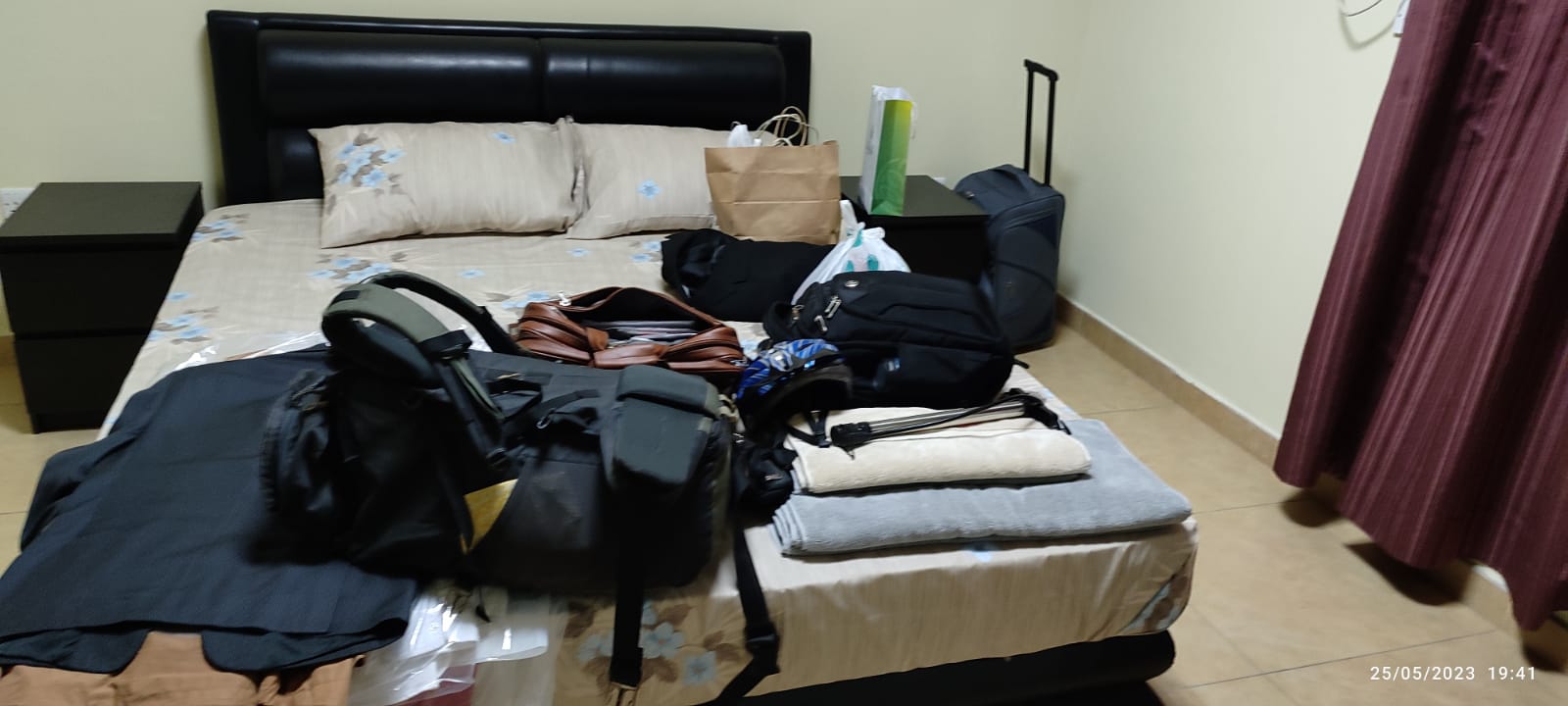
After 14 months, as I shifted myself into the flat adjacent to the school, it didn't give me sufficient ground to be proud finding myself still a man of baggage. I had 2 big bags, a back pack, and a lap-tap bag serving as a hold-all.   And I had some 6 plastic carry bags (all stored from the goods that reached me, and not one of them directly on my account) filled with stuffs - all the bottles (coffee, tea, and jam now converted into kitchen ware) to store some snacks, and now, if warranted, some masala; one with my footwears (from a single pair of rubber slippers as an MA student, now I have at least 4 pairs for various uses);  and from a maximum of 3 pairs of regular dress (pants and kurta), now several, most of them dumped on me and not accumulated out of desire. 

The only stuff I have added after coming here is a shirt imposed on me by the manager, a power bank, a mobile holder cum speaker, a 2 TB portable hard disk, 3 new books (heavy)... all came as unsought gifts!!  So, these do not permit you to go freely as you would want to, books, usually, I donate to the library after reading.  

Baggage dumped in the apartment bed room       On arriving at a residence, and starting afresh, I  realise the taxing aspect of it - which I had been spared all these years. Even now, with the support given by the school management, it is very minimal. Still, I feel the burden, which, if no other way, I will still bear, without fuss or cribbing.  But I realise the freedom I used to have in this matter.  Arriving at the new flat, just behind the school campus, I found vessels, dishes, some provisions, a refrigerator, a four-unit stove, which has an electric switch to let the gas burn with a spark, a microwave oven, a mixer/grinder, a bread toaster (I have hardly had any bread in my hotel stay), and a set of crockery.  Mind boggling (according to Simba, mind iz blowing)!! That to live alone in an apartment, one has all these requirements! Likely that I will have to go out to secure provisions for the kitchen in the coming months. 


Tuesday, 23 May 2023

Global Tiger Day

Precluding a Planet without Panthera Tigris

As I take the 3-hour boat ride in the brackish waters of Sundarbans creek from Basanti, South 24 Parganas with a keen desire to have a view of the great Royal Bengal tiger, the national animal, in its habitat, I am aware of the saying: ‘while you may not be able to see, you are being seen all the time’. You feel safe as you are far away from any direct contact with the mighty forest king. The darsan of the charming fellow planet dweller, is not easily granted, it may take several days or several trips. I decide to take the less adventurous path, and reach out to Nandankaanan in Bhubaneswar, where the darsan is almost sure, though in captivity of some 437 ha, with the deceptive appearance of the wild.  And I am blessed with one of a white tiger, a pre-Adiga[1] one.

Some Feline Facts

Tiger is the largest living cat species and is symbolic of the beauty, majesty and power of nature. It is identifiable by the dark vertical stripes on its orange skin and white underside. 

The tiger has been found adapted to a range of environments from the cold Siberian taiga, reaching to −40 °C to the Sundarbans mangrove swamps where Mercury climbs to 40 °C.

The big cats remain in the forest eco-systems at the top of the food chain.  The different genus under the sub-species of Felidae of big cats are: Tiger (Panthera tigris), Lion (Panthera leo), Jaguar (Panthera onca), Leopard (Panthera pardus), Snow leopard (Panthera uncia) and under the sub-species of Felinae are: Cheetah (Acinonyx jubatus) and Puma (Puma concolor). 

The largest among the tiger species is Siberian tiger (Panthera tigris altaica), males growing up to 13 feet and weighing some 300 kilograms. The smallest among the lot is Sumatran tiger (Panthera tigris sumatrae), with males 7 to 8 feet in length and about 140 kilograms in weight. The most common among the tigers are the Indian or Bengal tigers, with the males attaining a body length around 9 to 10 feet including a tail above 75 cms, and weighing above 200 kilograms, though exceptionally bigger ones have been found. 

They sleep by day, and move around and hunt at night.  These mighty forest giants are versatile creatures that can attain a speed of 50 to 80 kms per hour on the land, and can swim, and if needed climb a tree (though younger ones are found to be more adept at it).

Family of Loners Tigers generally live solitary lives, on rare occasions, coming together.  The family units are seen attached to the mother, and even tending to pitch their solitary adult life closer to her.  As a norm, each of them keeps to a territory within which they manage their needs for food and water, while maintaining necessary contacts with each other. An adult male tiger requires 40 to 65 sq. kilometres to survive, but many are now forced to manage with limited forest cover, at times, leading them into conflict with the humans, peaking with man-eater episodes. They prefer to prey on large ungulates like deer or buffaloes or wild boars or even fish as their prey, while having an out-of-the-way interest in porcupines, in spite of the threat from their quills, is observed. 

World Tiger Day - Protecting the Predator turned Prey

July 29 is celebrated as International Tiger Day since 2010.  It reminds the world nations that tiger as the apex predator is the indicator of the health of ecosystem. 

When Prince Philip visited India with Elizabeth II in 1961, a trophy hunting was organised and a tiger was killed, which was reckoned as a feat becoming the royals. That was pre-project tiger times. Since then, India witnessed the major government initiative by name 'project tiger' (April 1, 1973), with focus on conservation of eco-systems.  It guaranteed the survival of the apex species and has led to a revival of the mighty cat.  In a matter of less than 5 decades the physically fragile human species had managed to decimate the mighty cats from over 40000 in the early decades of 20th century (according hunter turned conservationist E.P. Gee) to less than 2000 by 1970. The 'fragile human predator' could inflict greater casualty on the physically 'mighty forest leaders', on a much more devastating scale than the killer corona virus could do against the weakling anthropos.  This is a typical example of the destructive power and presence of the human species on the planet. 

IUCN (International Union for Conservation of Nature) has listed tigers as endangered, in its nine-category sequence (Not Evaluated, Data Deficient, Least Concern, Near Threatened, Vulnerable, Endangered, Critically Endangered, Extinct in the Wild, Extinct).   

Values of Conservation

Project tiger and other tiger conservation efforts have led to, our values of chivalry, self-discipline, spiritual powers etc. around wild life, taking a 180 degree turn around in the past few decades, indicating a transformative growth in environmental consciousness. What used to be an imperial sport is now a cognizable crime; tiger skin, which used to be the seat for yogis and god-men, is now not to be sought, nor to be possessed, and humans, at least in principle, agree that presence of tigers indicate also that the environment is healthy for all others including themselves. 

In 1947, it was estimated that India had just about 1800 tigers all over the country.  Today, after 50 years of project tiger, India boasts to have over 3000 tigers, and unofficially, claiming over 4000. 

Conservation efforts that began by declaring 9 sanctuaries covering ca.13000 plus square kilometres have expanded in 50 years into a large network of protected areas spreading over 75000 sq. kilometres in 18 states, 2.3% of Indian territory. Today India is a leader in conservation practices, and a proud protector of 70% of the world tiger population. 

Tiger Day is the celebration of life and its diversity by an enlightened generation of human species.  It speaks about the importance of forms of life other than humans for healthy living and survival of species, including the humans. The very beauty and majesty of the tiger is the indicator of the power and vitality of nature, something in itself, worth celebrating.  Like the poet William Blake, such is the manifestation of power and beauty, that one is easily taken beyond the mundane to wonder: 

Tyger Tyger, burning bright, 
In the forests of the night; 
What immortal hand or eye, 
Could frame thy fearful symmetry?

Conservation Challenges

The challenge lies in how to harmonise the irrepressible human urge for progress with the survival of other species. The intelligent humans have to find rational and sustainable solutions to this vital issue, especially as humans become the victims when conflicts with the wildlife under conservation emerge in human habitats on the forest fringes. 

In the hay days of tiger hunting, it generated ample literature, narrating the adventure, and guiding the humans as to how to effectively undertake 'the perfect masculine sport'.  Thus, we have, Tiger Shooting in India (1857), by Lieutenant William Rice, The Wild Sports of India (1857) by Bengal Army Captain Henry Shakespeare, the two-volume India and Tiger-Hunting (1885) by Colonel Julius Barras, and Forty Years Among Wild Animals in India (1910) by F. C. Hicks, with systematic theorizing of tiger-hunts.  First signs of conservation attempts can be seen in the campaign by entomologist E. P. Stebbing, through magazines like Bombay Natural History Journal, for elaborate game-protection laws, and licensing. W. S. Burke’s The Indian Field Shikar Book (1920) compiled the game laws in every Indian province in its appendix.

Today, the literature demanded is that of creatively conserving the species, balancing the same with human progress.  The Ministry for the Future (2020) by Kim Stanley Robinson exuding great optimism and an integral vision about future course of human action, I feel, is in the right direction.

India has witnessed the extinction of Asiatic Cheetah, the apex species in the regions around Punjab, from its terrains by 1940s, and efforts to reintroduce them from Africa (Namibia) are on, with mixed reactions from scientific community and conservationists.  A much more vibrant effort is happening in Patagonia (Argentina - Chile) to revive Puma populations, the apex species in that region (earthrise series of Al Jazeera[2]).

Tiger conservation implies eco-system conservation and care for bio-diversity.  It requires also collaboration among people, among regions, and as in this case, among nations.  Ideally, Bengal tiger protection would require collective efforts on the part of India (and the different regions within it), Bangladesh, Nepal, Bhutan, and even China (Tibet), which is an indicator of the direction to which a sustainable world should move - of partnership and collaboration for sustaining life on the planet. 

As I conclude these ‘tiger thoughts’ I am inspired by the religious icon of Swami Ayyappan, riding a tigress, one of the most popular deities for the South Indians, with millions visiting his abode in the deep tropical evergreen forests of Sabarimala of Western Ghats. He symbolises how the humans should live and the direction in which they should grow – living in the depth of the forest and letting the forest be, and living in a harmonious coexistence with the king of the forest, the mighty tiger(s). There is no threat to each other. 

I also recall how the wildlife photographer, N.A. Naseer, in his autobiographical reflections, narrates his encounter with the mighty tiger: there is no animosity or threat to each other.  The mighty creature is sure of no-harm from the co-existence occupying what is otherwise his space, they assess each other, and accept each other.  And he willingly gives in for a memorable shot. There is a spirituality of mutuality of the planet dwellers, which Naseer’s narration in “Reaching out and Touching the Forest” (Kaadine Chennu Thotumbol, 2019) carries, which is the direction such observances should take us to – a spirituality of earth family – vasudhaiva kutumbakam.

<https://en.wikipedia.org/wiki/International_Tiger_Day> May 20, 2023

<https://en.wikipedia.org/wiki/Project_Tiger> May 20, 2023

<https://en.wikipedia.org/wiki/Bengal_tiger> May 20, 2023

<https://www.nytimes.com/2023/04/09/world/asia/india-tiger-conservation-success.html#:~:text=In%20the%20early%201970s%2C%20things%20looked%20grim%20for,is%20part%20of%20a%20complex%20but%20fragile%20ecosystem> May 21, 2023

<https://www.britannica.com/animal/Bengal-tiger> May 22, 2023

<https://imperialglobalexeter.com/2018/09/17/shooting-tigers-in-early-20th-century-india/#:~:text=Hunter-turned-conservationist%20E.%20P.%20Gee%20estimated%20that%20at%20the,their%20numbers%20had%20dwindled%20to%20a%20meagre%204%2C000> May 22, 2023


Wednesday, 10 May 2023

ENTREPRENEURIAL EDUCATION (EE)

In our intra-community meetings, two of us perhaps stand out for our bending of any issue in a predictable direction. One, my good confrere Varghese (a very creative and articulate mind, who has survived a terrible attack of Guillain-Barret syndrome - GBS, and bounced back to life - fully), who has an entrepreneurial tweak to almost anything discussed (earlier it had more to do with his pet project - Pallikutam, the monthly magazine on education, as the one stop solution for almost all the ails of the world), but with indeed some powerful argument, and awareness regarding the trends, and his own take on what entrepreneurship (or ism?) is all about. Two, my own self (I presume so), having an environmental/sustainability angle to almost all issues. 

Besides authoring a highly creative work 'entrepreneurial intellection' (wow!!), he has, with a kind of propagandist zeal, managed to convince himself, and make a few others, sense, that there is indeed a Chavara legacy of entrepreneurial ethos or even, spirituality! Though grudgingly, I give in, till counter proof is produced. 

Entrepreneurship angle was not alien to me - it started off from the good old days as a student of Social Work, and I continued harping it all through my educational career, but not really knowing how to promote it or cultivate it, except talking about it to the students. I have often found that trained social workers were found to be best employees, willing to take up any task, stretch beyond the time schedules, do things more systematically, document and communicate better than a typical office worker having a graduate degree.  The training of repeated reporting and personal and group (at times, rigorous & critical) interviews, and regular presentations help them to be. But when it comes to being an initiator, they lag behind.  They are found better equipped to sustain what has been initiated by pioneers like Rippen Kapoor (an Airline employee turned a sociopreneur who initiated CRY), or Vandana Shiva, the atomic scientist turned entrepreneur behind BIJ, New Delhi or several such ventures. 

So when one of my young students Prashant, and his wife Seema  stepped into almost initiating a full-fledged organisation in Orissa, I was thrilled to see a streak of entrepreneurship flourishing. He did manage to do good to communities and a region, but also managed to support himself decently, I believe. Yes, such ventures now a days fall into the category of sociopreneurship.  But do they, really?  What could justify the suffix of 'preneur' to a prefix to create new portmanteus like sociopreneur etc? 

I think, beyond the initiative and innovation angle, the leadership and risk-taking involved, the suffix is justified when it is able to generate wealth and sustain itself.  

Attending the on-line webinar of CATALYST to promote innovation and entrepreneurship, I was eager to see the kind of initiatives being taken as start ups - solutions for problems that are also wealth generating and with some initial support, self-sustaining.  I hear that organisations like Ashoka foundation, Catalyst etc. try to promote this spirit.  Youth are invited to present their ideas on addressing issues through projects that could sustain.  Ashoka website reports that within ten years of its entry into the field, it could achieve its goals of establishing social entrepreneurship as a viable approach to addressing social issues. 

My invovlement in a project with a small time funding for India to address the issue of poverty generated 15 responses of which there was hardly anyone which had a fresh approach towards the issue.  But having had the funds available for experimenting, we decided to allocate them to the proposals that seemed genuined and that would sustain. One among them stood a little apart in that it was meant to promote farming with women getting involved, and employing organic methods. They proposed they would try this out for a year, and if found successful, would scale that up. 

I recall our smart management student Suraj, who would have really faired well in academics, choosing an unexpected track after a stint with some managerial positions, chose to walk the less travelled road, by initiating a venture named planatearth (also plan@earth) with focus on waste management - collection, segregation, recycling and upcycling - with women as partners or staff.   It is described as non-profit.  But I am sure that at least 50 people earn an honest living from that. 

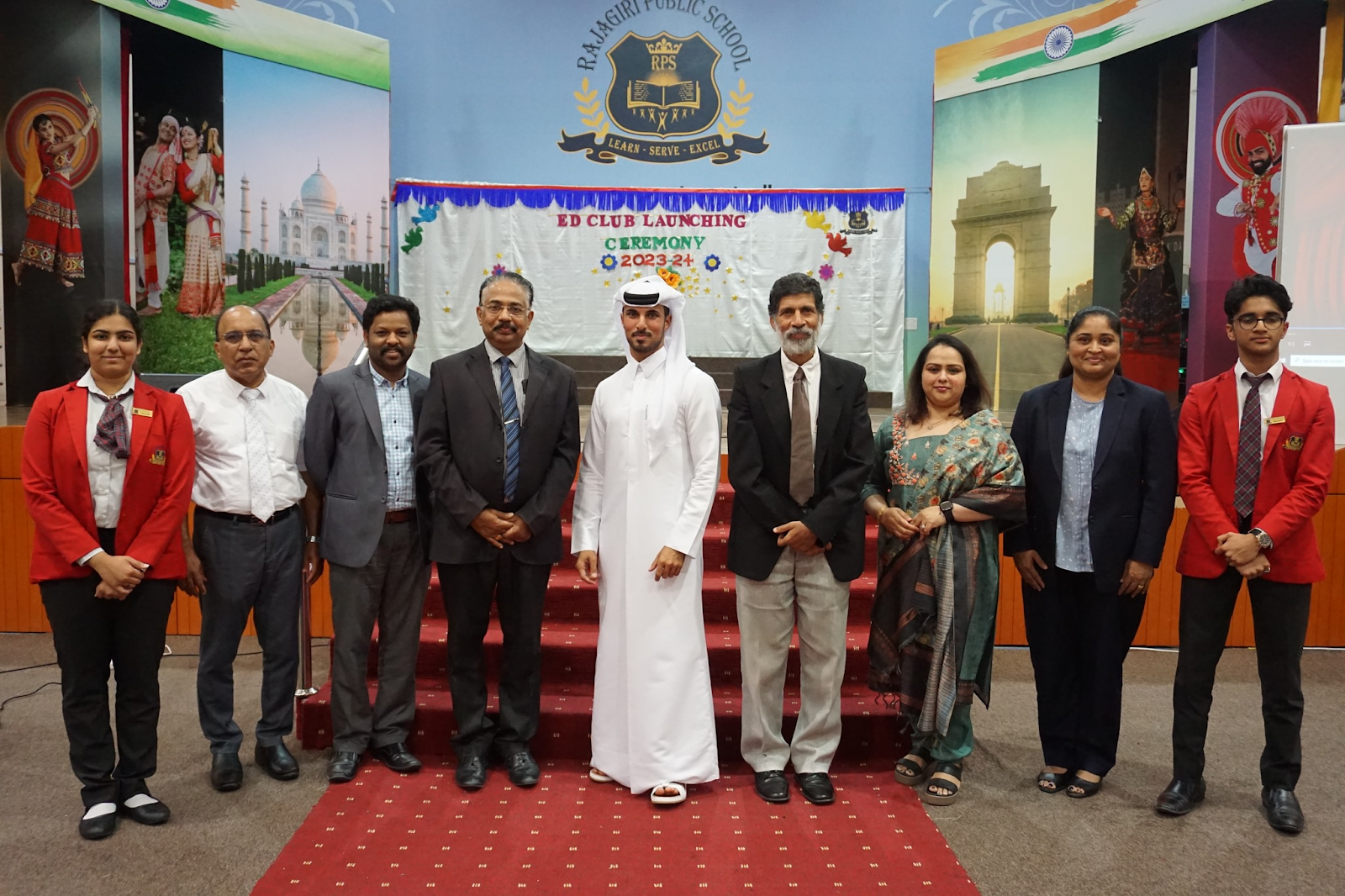
I am glad that, as a young school, we are inaugurating an entrepreneurship club - to what extent it

would do justice to that name, I am not sure.  However, the inauguration of the club was befitting - with young American-educated, green, engineer-turned, Qatari entrepreneur Ghanim Al-Sulaiti, arriving in style and presenting his short trip up the summit he is right now - of a green entrepreneur walking (in this case, riding a Tesla) the talk - proving that waste management is not only a virtue but a sellable entrepreneurship, with his office managed as zero waste, employees (some 250 plus) mandated to use public transport with provision of free metro cards to each, and even water bottle being envisioned and produced as biodegradable.  His ventures include Evergreen Organics, a vegan restaurant at Hamad International Airport, Green & Go - a healthy fast food joint, Mylk - a vegan susbtitute for dairy products, Paper-cut - a sustainable paper based packaging venture... He has agreed to provide the school with such water bottles, subsidising it for propagating the idea.  Here is a modern day youthful spiritual person, not because he chosen a vegan life for himself - but for the set of 21st century virtues he exudes. 

As a believer, I feel 21st century virtues for youth should be in this range: 

1. I shall not seek any job from someone. 

2. I shall create a job for myself

3. I shall generate job for another ten. 

4. I shall not generate waste

5. If I generate waste, I shall manage it without harming the planet.

6. I shall manage it and generate wealth out of waste (WoW)

I hope such virtues will be engendered through 21st century education, and there will be an array of innovators with the suffix 'preneur' - edupreneur, agripreneur, coopreneur, silvapreneur, aquapreneur ...

I am inspired always by the statement of the protagonist of Shaw's science fiction 'Back to Methuselah', when he says: There are those that look at things as they are, and askwhy.  I dream of things that never were, and ask why not! 

As an educator, I feel good if we can enable the learner to look around, see the things as they are, and ask why.  For often, the learner, sick with ennui,  is not even bothered about what, who, where and when, let alone the hows and whys.  However, I feel today's education will lead to making the world a better place and life really worth living, when it can lead people to imagine things that never were - like peace, and dare to ask 'why not'. 

P.S. As I made these notes, I thought I would turn entrepreneurial by creating a holiday for entrepreneurship - and lo and behold, that is already there.  August 21st is dedicated as World Entrepreneurs' Day.


Some 21st century Entrepreneurial Stories

https://www.youtube.com/watch?v=q0OQMBA0m2U

https://www.thebetterindia.com/262204/plastic-bottle-wrapper-recycle-fabric-manufacturing-young-entrepreneur-sustainable/

https://www.thebetterindia.com/web-stories/homemaker-revives-dying-lake-in-bengaluru-plants-thousands-of-saplings/

https://www.thebetterindia.com/web-stories/kerala-entrepreneur-shares-how-he-earns-lakhs-growing-microgreens-at-home/

https://www.thebetterindia.com/web-stories/i-planted-thousands-of-trees-with-my-community-to-make-odisha-greener/

https://www.thebetterindia.com/web-stories/how-to-grow-apple-almond-trees-in-half-the-time-using-air-pots-kerala-farmer-shares/

Sunday, 7 May 2023

Vaikom Satyagraham

Lessons from a Struggle for an Egalitarian Society – Reflections on the Centenary of Vaikom Satyagraham 1924-25.

I have read or learnt about Vaikom Satyagraham as an event in the history of Keralam, and it is there in the background of our thinking as a great step of the region in the direction of egalitarian society.  However, the lessons of those days have hardly transferred any bit of the spirit that was in the revolutionaries.  We read that almost 50 years after the event, and now we are 'celebrating' its centenary. 

Being away from Keralam, and not really feeling enthusiastic about following the happenings of what has now become 'dogs' own country', where dogs, elephants, hogs and leopards have people and the state to fight for and assure their right to live, whereas, the forest, the coastline or the high-range dweller is under the constant threats from this very state and these fellow beings of the animal kingdom;  I don't follow Kerala news.  So, it was by chance, that this centenary celebration with Tamil and Malayali makkal joining hands together, caught my attention.  That Malayalees and Tamils are joining hands for one cause, is one salutary outcome of this event, though it has taken 100 years for the same to happen.  

However, bravo! From 30th March 1924 to 24 November 1925! 1 year, 7 months and 25 days - a really persevering venture. A group of people with courage of conviction, fought for and suffered for a cause - for an ideal that is named 'equality'.  The sheer element of perseverance of the 'truth seekers' or 'truth clingers' (satyagrahis) is what fascinates me. And I salute the government of those times of Travancore, for their being human when compared to several modern democratic states which easily wipes out any such protests, and decimates any such protestors - even as I read with shock the passing away of a passive Palestine resister Khader Adnan after 86 days of fast (12th in his life of revolt totalling just 45 years) in Israeli prison.  The treatment meted out to the protestors against Silver Line railway, in this 21st century, by a democratically elected people's government, also appears cruder than the treatment received by the satyagrahis of those days from an autocratic government led by someone based on inherited might, and hardly anything to do with the people's will. 

The lessons for me from this outing are basically about individuals - participants, supporters, influencers. 

The first is a set of individuals - basically belonging to the Indian National Congress of those times - K. Kelappan (Kerala Gandhi), K.P. Kesava Menon and T.K. Madhavan. While, perhaps none of them was a direct victim of casteist injustice, the latter definitely bore the brunt of being born into Ezhava caste, on which was enjoined a degree of untouchability. While he was the real spirit behind the movement, the active frontline involvement of those who happened to be (on the side of) perpetrators gave strength to the movement. T.K. Madhavan's perseverance in the cause is to be appreciated.  Failure of his effort in the Sree Moolam assembly five years back (1917-20), gave him time to think over and strategize, and get nationwide endorsement in the Kakkinada congress of 1923, and the support of the state congress leaders. 

But my salutation also goes to the very many nameless volunteers who joined the sit-in day after day, facing the threat of arrest, and yet continued the struggle for over a year. 

I notice the presence of Amchadi Thevan, the one figure conspicuous in a picture of satyagrahis, by the absence of a shirt on him. He is from Poothotta, now part of Ernakulam district, just across the river dividing the two regions. Glad to see this representation from the dalit groups of those times, and the belated efforts to honour and perpetuate his memory. 

The beleaguered congress party of today should take a cue from the lofty ideals that inspired the party of those times, and reinvent itself from the kind deplorable mood of dissipation, despair and disunity that prevails in the party.  If it were to exist, survive and win, it needs to be of and for the people, and identify the issues that affect people, and identify with them. Ultimately can it reinvent itself as party that stands for justice? 

Four stalwarts noted by their involvement/non-involvement in the stayagraham were: 

1. Mahatma Gandhi -  whose intervention is said to have generated the compromise formula - I cannot make a judgement on that.  However, Gandhi was with the satyagrahis, and his instructions had lent it the non-violent strength it possessed appears evident. All the same it was a compromise, about which Gandhiji was frustrated. Compromise involved opening 3 sides of the access roads to all communities, but restricting one side which was said to have exclusive privileges for the Brahmins, and the release of the satyagrahis imprisoned in this struggle.  But it heartens me to note that his challenge to the crown prince to do full justice to the discriminated communities was responded to in earnest, and his voluntary yes, was translated into the Temple Entry Proclamation Act of 1936, 12 years after the struggle, but without much delay after his ascending the throne.  I have only sympathy for Rani Sethu Lakshmi Bayi, who seemed to have been unable to get out the prison of her hierarchical faith (read caste) perception, but still was willing to give in, unlike some of the present-day popular governments. 

Though Gandhiji's advice to the Christians and the Sikhs involved in the agitation to step out of what was a Hindu affair appears alienating, I feel that it was the safest position in this regard, especially, this having more to do with a practice within a religious community.  While caste hierarchy segregation could have been seen as an internal matter of a particular community, when it comes to violating rights of the citizens, it could be a cause for anyone to intervene. The case in point had also issues of civil rights of mobility and use of public space.  From this angle, the instruction to step out was perhaps not the best counsel. Perhaps, his 'ever growing truth' had not grown enough by then, to give priority to the civil rights aspects over the internal matter of caste issue within the Hindu fold. 

2. Sree Narayana Guru -  who kept aloof from the struggle, as to him the demand should have been for the entry into the temple itself, where all should have entered by any means and make it impossible for anyone to observe untouchability. Guru as ever, was radical, but I feel the radicality should have been in the pattern of his ingenious installation of an 'Ezhava Sivan' rather than of seeking entry into a Brahmin dominated place of worship. I wonder whether he ever had the desire to be part of the larger fold, or would have rather preferred to uphold and reinforce the dignity of the unique Ezhava identity. The restrictions should have been challenged by such assertion of such identity I feel. It doesn't mean that I am not for the unity of the so-called larger hindu fold.  Unity is welcome, but should definitely be in terms of equality among all who adhere to the fold.  However, the struggle has led to the various divided castes of Keralam to be united as an organised religion, which was hardly ever status before. 

(I am not claiming in this matter, Christianity, at least its Indian version, has escaped the crude reality of caste discrimination.  Though, theoretically and theologically, Christianity would not accept caste, and would treat the same as un-christian, in practice, caste has been there, and still persists within it.  Nor can Christianity claim true Christian practice of egalitarianism, in several other parts of the world as well. Even today, any educated Malayalee is willing to complete any government related proforma, where an unwarranted caste slot is filled without any hesitation, making entries like Roman Catholic Syrian Christian or any other such community, in the slot for caste!)

3. E.V. Ramasamy ‘Periyar' - (then with the congress party) who joined the agitation with his wife Nagamma. Both were arrested. He earned the title of the 'hero of Vaikom' (Vaikom Veeran).  He too was not in favour of any compromise in this regard, and was not happy with the outcome. 

4. I feel good finding the Nair community leader Mannathu Padmanabha Pilla who is seen leading people in protest march against the discriminatory practice. He is bold and free enough to criticise the stance taken by the Queen by pointing out that she had given into the Brahmins. His involvement as the community leader of a caste group that didn't have the sufferings related to untouchability, is an indicator of enlightened minds in the community, even in those darker days. 

5. Would add a fifth, Barrister George - I am happy to see one Christian name among the leaders, at one point of time, even leading the struggle, when all the rest were arrested - not necessarily for his involvement in a matter of another religion, but for the matter that his presence indicated a public spirit among Christians as a community in those days, about which even as a Christian, I had the impression of its being a very inward looking, almost a caste-like community. 

I marvel at the spirit of justice in the people from Punjab, Tamilnadu and Keralam, cutting across the boundaries of communities, inspiring them to take the trouble to travel to this Southern tip of India and participate in what they had perceived as a just cause. Though this spirit is prevailing even today, when we compare the mobility and communication facilities of both times, I feel the spirit in the present generation leaves much to be desired. 

All said and done, in my analysis, this was a healthy move from within to purify and refine one's religion and this is expected of every true religion (Gandhi's stance) - a Church axiom attributed to St. Augustine (4th century) in this connection would read: Ecclesia semper reformanda est - the Church must always be reformed. 

My readings reveal not just the inspiration from Mahatma Gandhi, but also the intelligence of the maverick bureaucrat of those times, Sir C.P Ramaswamy Iyer, in working out this step, really radical for those times,  by Sri Balarama Varma.  CP's studied assessment of the situation made him realise this was in the best interests of the state of Thiruvathankoor (southern part of the present Keralam) and the king, and also for the larger fold of hindu community, which might otherwise face a threat of erosion by way of conversion to Islam or Christianity. His legal and intellectual acumen made the act possible, ironing out all objections likely to rise from all possible angles, and highlighting the voluntary aspect of the decision as the greatness of the ruler. In spite of the iron-handed rule of terror for which CP is more known in Keralam, I respect his concern for the  hindu community, his knack in foreseeing the trouble, and his loyalty to his employer (the king) – perhaps, in his hierarchy of values he saw this above the welfare of the masses, and whom he, perhaps equated with the state itself. 

I also notice Vaikom the stage of this revolution - a town familiar to me from my childhood. In 2018, together with a bunch of our students we went riding bicycle up to the place where Mahatma Gandhi visited, paid our tribute on Gandhi Jayanti day.   It is still a sleepy town - it has not really had any drastic difference from the time I had been seeing it - now for almost 50 years, except that there has been a memorial to MGR who is said to have been from there. It does not show any spirit of vibrance of progress - not necessarily economic.  Nothing phenomenal in the town or nearby villages as far as participatory governance is concerned, there had been tremendous exploitation of sand - deposits of river-sand found in various parts of the region leading to exploitative sand mining about a decade ago; the rich paddy fields around are generally left fallow and uncultivated, the picturesque water bodies are not intelligently utilised or maintained for overall benefit of the region. Though I have nothing against huge infrastructure development not happening there, optimal utilisation of the existing resources appears lacking - for a place that has witnessed such historic revolution, a spiritless existence! 

My last reflection is about the long-lasting effect it has had on Kerala community, which, all my reservations about it having gone to dogs notwithstanding, from my experience of having travelled and lived in different parts of this country, would still be rated as numero uno as far as freedom of speech, freedom of mobility, freedom of expression are concerned. This is now being increasingly threatened with fundamentalism gaining grounds within religions, neo-revivalist movements within them tending to find matters that divide than unite among religions. Perhaps, the dominant manipulative politics of pure convenience, with the sole agenda of grabbing power for pleasure is spreading its roots  within the religions too, bringing them down to earth, instead of the transcendental plains they should take their adherents to. 

I feel grateful to be living here, at this moment, enjoying the great blessings of freedom, mobility, and equality – at least in principle! I don’t know to whom all exactly – to God, to those valiant revolutionaries, or to the Britishers, the struggle against whom led to this thinking, this revolt and the reforms?  I wonder if the latter were not to have suppressed us thus, whether there would have been a nation of this sort, or the very notion of equality of all humans, irrespective of their caste and creed.

But I do have greater hope in religions, being formally in the garb of a career religious person, and convinced that with all the genuine as well as unfounded allegations of irreligiosity, there is much greater goodness in those circles than what we can find today in the divisive and exploitative political circles.  As this episode was specifically about access around a place of worship, and leading access to places of worship within the hindu fold to all those claim to be Hindus, I would like to extend the aspect of access.  I am reminded of the biblical assertion: I will ... make them joyful in my house of prayer ...for My house will be called a house of prayer for all the nations (Is 56:7).  I feel like underscoring the section 'for all the nations'.  Can religions grow to be more inclusive at least to the extent that anyone is welcome to the places of worship, in so far as s/he is not doing anything that is against the decorum of the place?  If the places of worship are thought to be the dwelling place of the divine, then let anyone who seeks be welcome there to experience that! 

Thursday, 4 May 2023

CEREMONIALITY TO CENTERED ACTION - STUDENTS COUNCIL 2023

Ceremoniality 2022-23

With a year gone, and ceremonial heads, notwithstanding their goodness (real good souls!) and talents, having remained literally ceremonial, and thus being a disappointment to me personally (I don't think anyone else feels thus), I look forward to another academic year with a greater involvement, engagement, participation of the democratically elected student council. 

A Platform for Democratic Leadership Practice

I think the election process, a training in democracy, as practised here, is a laudable one. It is not just anyone opts to contest, and the students vote, and s/he gets elected.  No.  There is a combination of factors taken into account, making it, to my mind, a more meaningful one. The students can submit nomination as prescribed.  All the portfolios are reserved for the senior batches - with 12th graders having the full office, and the XI graders as assistant.  The offices are Head Boy &  Girl, Captain, Cultural Secretary, and House Captains - altogether 16 posts. There are also 4 prefects each from  IX & X grades.  Except in the case of head boy and head girl, all other posts are open to any gender. Any violation of the election by-laws or even, regular school code of conduct, can disqualify a candidate.  At least one such instance occured during this election.  Then there is an interaction with a faculty team by the candidates and this is given a weighttage of 20% and their academic merit is given another 20%, and 60% weighttage is given to the student votes.  This time, there was big rush for contesting for the posts, which we deem as a healthy sign. The campaign also was vigorous, though, I feared at times, it crossed the set limits, and had a flavour of the typical politicians' campaigns with appeasing promises. 

I felt that prior to their taking the oath in the elegant and colourful ceremony, they should be called for a discussion on the norms and the roles they are expected to play, and the trends of violation that were observed during the campaign.  It was done, though I do not know what transpired there. 

The auditorium was decorated beautifully, but in a simple manner.  I was glad and thankful to see that the usual bunch of balloons was missing. With some element of marching to the drum beats incorporated, the system of leadership practice seemed to integrate fitness, discipline, talent, academic acumen and popularity. 

All those who held senior academic admin positions of the school were involved in investing the members of the council.  It was all well ordered with the physical educal department guiding the show. The march, the colourful sashes, the badges, the placard... the receiving and transfer of these symbols all added to the charm of the pageantry.  The section head Mr. Ben Antony in his prefatory note succinctly presented the purposes and the processes involved.  A video showcased the highlights of the process - with better planning some campaign elements could have been included. The compering team of Mr Regal and Ms Silvy placed the pieces in proper perspectives. Unstoppable was sung with great gusto by the school choir, and a dance on 'shiksha' added charm to the solemn gathering.  A video show on leadership was inspirational with APJ, Obama, Ratan Tata, Greta Thunberg appealing to the elected leaders! 

Investment with Great Expectations

1) My thinking for the day was about investment - while investing them with power and authority to act, we were also investing in them our hope for future leadership in various fields - 24 of them in various leadership positions. And the school, the management, the students, the parents all were investing their time and energy for them being thus invested. I hope they in turn become our investment for the common good and the good of the institution. 

2) I hope that they will go beyond the ceremoniality to practicality and innovative approach to identifying growth avenues and promote them. Today, the newspaper proclaimed the passing out of Qatar Foundation graduates in STEM mode, and claimed they possessed the attributes of innovation, problem solving, addressing the issues of climate change etc etc. I wish that these youngsters have that spirit infused  in them.  That they are able to think beyond the curriculum, class room and the school, to enlarge the scope of their learning to the outer brighter world. 

3) I hope they will find opportunities to widen their horizons by engaging with organisations and people for sustainability especially by basing their actions on the goals, the school has planned to work on for the year,  of removing hunger (food), climate action (reducing the carbon emissions) and establishing collaborations with local and international organisations. Big dreams!!

4) I hope they will also show leadership in compassion starting with campus where no one is left behind, but going beyond the border to establish their solidarity with the suffering and the deprived segments of humanity, while we are privileged to live in peace! Be it Rwanda where 127 people have been engulfed by the fierce force of floods, or Belgrade where 8 young lives and a teacher have been lost to the bullets of a fellow student, or the Ukrane where the children have lost their childhood and education, and at times, lives, on account of the war, or Sudan where thousands are on the run due to civil strife... I hope their leadership will find a way to connect the campus with such segments in solidarity. 

5) Finally, today's newspaper presents to me a great leader - none other than the football god Messy - but being censored by his club for having violated the rules laid down for him, for having travelled to Saudi Arabia without permission.  At least, good for us to remember that systems meant for all have to be adhered to by the leaders as well! I hope that will be remembered by the invested leaders that individuals, while each of them being important and as such irreplaceable, still, irrespective of all that they are, should not deem themselves above the law, and are also replaceable!!

Stepping Stones to Leadership: An Open Text Book of Hard Earned Experience

Mr S Xavier Dhanaraj, the first secretary in charge of visas, passports and community affairs gave the investiture address, which we also termed as the inaugural address of our version of 'TED talks' - Rajagiri Excelsior Lecture Series (RELS).  With my first meeting, I felt that his experience could inspire and challenge students and teachers.  He began by presenting the very  significant tasks he performs in his office to contrast them from the background from which he came. He shared his experience of growth into leadership - of his being struck by the predicament of his father who could not get for his son, a sought-after branch of studies on account his low score; of being inspired by a teacher who taught Tamil and generated interest in the subject in him; of identifying his strength; of recognition by a teacher motivating him; of the importance of passing on information on opportunities and the role of the school in it; of being determined not getting dissuaded by failures; of accepting failures and identifying one's weakness and working on it, of incessant and repeated practice; and  of intelligent strategies targetting your potential promoters. He felt proud to present himself as the son of literate (merely) parents who are still pursuing agriculture, but still was able to rise to the top leadership cadre of the nation -  thanks to the one great leveller, education! 

I felt good that he shared his experience that at least a few would have a thought in that direction, but more than that the challenging role of the teachers to inspire, to mirror a student potential through recognizing that in him,  to motivate and to inform him that he grows and blooms!  That is the challenge. 

In spite of the sharing going beyond the typical attention span of school children, the audience behaved - primarily, I think, because, the honest and touching experience was the text, secondly,  they decided to keep up the honour of the school. There was sustained applause when he stopped - which is unusual, and standing ovation is not yet a spontaneous reaction in Indian culture. I feel grateful - both to Mr. Xavier for his valuable time and  the open text book of his experience earned the hard way, and to my students for their matching up to the occasion! 

As usual, our board member, Dr Aju had his words of wisdom to match the occasion. His stress was on experiential learning, for which this election process was a case in point.  He listed the leadership qualities that should emerge out of such experiences, including creative thinking and the ability to experiment, and accept that some experiments may fail. The experiential learning is also to serve as a lesson in teamwork, involving and inspiring others. 

Now the floor is set and open, it is up to the student body to think, visualise, and take steps that would make their titles. Reiterating, I would rather,  they take up the school framework for action this year - of sustainable development goals 3 (no hunger), 13 (climate action) and 17 (collaboration) for their innovative thinking and action, and make an effort in the direction of the school being an eco-school.  I hope the team becomes 'unstoppable' in finding avenues for creatively spreading goodness.