Sunday, 30 June 2024

Resolving the Syro-Malabar Crisis - An Appeal to the Holy Father

To The Beloved Holy Father of the Church on Earth, from a few clerical members of the Carmelites of Mary Immaculate (CMI)

cc: Major Archbishop Raphael Thattil, Archbishop Leopoldo Girelli - Apostolic Nuncio to India

Beloved Father, greetings and peace from the Church in India!

We would like to bring once again to your attention that we are deeply concerned for the Church to remain core to the message and person of Christ.  Though these matters have been brought to your attention from various sections, however, we are prompted to reiterate them and our concerns. 

As it has been communicated to us, you have pointed out that issues of liturgy have to be sorted out amicably at the level of the sui juris church itself.  The changes introduced in the Liturgy in the past few decades are indicative that this can be done and that there is no such absolute untouchability to the text or the rubrics, than what is beneficial to the celebrating faith community as decided by the synod (in a synodal spirit; not necessarily by mere majority). 

We are all for the unity of the Church, and those of us who had been in the practice of celebrating the Eucharistic Liturgy ad populum for the past many decades, have not felt any lack of unity, when we had to celebrate the Eucharist in the Chaldean way when the celebrating context was such.  We have never felt that such uniformity is required to maintain Christian unity.  If that were the case, we would not feel unity with the Holy Father or the very many neighbouring church communities who celebrate the mass in the Latin rite. 

We feel that the test of accepting a form of the ritual should also take into consideration how that communicates with the community of the faithful concerned. The Latin rite liturgical form adapted for children gives us the confidence that in the Church, such flexibilities are possible.  In this case, some matters appearing very trivial and highly ritualistic are raised as matters affecting unity, howsoever rich in symbolism they are purported to be - a) turning towards the altar and away from the people; b) having a separate table (Bema) for the liturgy of the word!

When the Holy Father sets a Christian example in trying to reach out to people considered to be in 'sin' - e.g.,  those in same-sex marriage or partnerships, those who are not married as per church regulations - to threaten almost 600000 people including their validly ordained priests with the medievalist and unchristlike excommunication threat, for the simple reason of not following the synodal decision of celebrating the Eucharist ad orientam, appears appallingly against the Spirit of Christ. 

There has been a clever manipulation bordering sentimentality of two principles of Catholic Christian life - (i) communion with the Church and (ii) obedience (including, obedience to the Holy Father). We feel the apparent intolerance to differences/diversity and blind adherence to ritual vestiges of an archaic tradition is a graver danger than the insistence on a tradition that has taken root in this region over the past six decades or more - with the majority of the present-day priests and the faithful having been born into it, and trained in it, and accustomed to it.  

Our humble requests to the Holy Father are: 

1. Permit the variant of the Eucharistic Liturgy as practised in the Ernakulam region as a valid Eucharistic celebration, till further consensus is reached on the issue. 

2. Instruct the synod and the episcopal leadership to avoid unchristian threatening language in eliciting compliance from the believing community. 

Looking forward to your paternal intervention, 

Your sons in Our Lord, 

1. 

2. 

Friday, 14 June 2024

Resolving the Syro-Malabar Ritualistic Rift

On one of my rare evening meditations, on the feast St Anthony of Padua, the great preacher and critique of clergy of his times, the gospel presented to me was the death of Jesus.  Mtt 26:47 ff. where I read, 'then Jesus, crying out again with a loud voice, gave up his life (50). And behold, the veil of the temple was torn into two parts, from top to bottom...'(51). 

Isn't this gospel narration of the tearing away of the curtain of the temple signifying the demarcation between the holy of holies from the rest of the temple a pointer to the new phase in God-human, God-world relationship where such separation was not warranted; where God was no longer the punishing unapproachable God who wouldn't let anyone come near him, whose special presence was to be separated by a veil, lest those who approached it - human or animal - would be burnt to death, but rather, a God who dwells amidst people, with God's reign being established here (Lk 17:21)? 

I feel one of the consistent agendas of Jesus was to liberate people from slavery to rituals, but we are here literally being enslaved by ritualism, and behaving in an unchristlike fashion to preserve them or to challenge them.  Psalms (74: 4-11) of today's vespers aptly fit my meditation on Syro-Malabar Church of Ernakulam: 

O God, why have you rejected us forever?
4 Your foes roared in the place where you met with us;

5 They behaved like men wielding axes
    
to cut through a thicket of trees.  

6 They smashed all the carved paneling
    
with their axes and hatchets.
7 They burned your sanctuary to the ground;
    
they defiled the dwelling place of your Name.
 8 They said in their hearts, “We will crush them completely!”
    
They burned every place where God was worshipped in the land.    

no prophets are left,
    and none of us knows how long this will be.

10 How long will the enemy mock you, God?
    
Will the foe revile your name forever?    

11 Why do you hold back your hand, your right hand?    Take it from the folds of your garment and destroy them.  They set up their standards as signs. We are given no signs from God...

Christ must be laughing at the incorrigible human nature which always wants a  'golden calf' to satisfy its aspirations, which in the Catholic Church, especially in the Syro Malabar church, has taken the mould of the elaborate ritual symbolic of the thanksgiving and self-effacing meal Jesus celebrated.  We have succeeded in making it a magical formula with grand narratives being written on the real presence,  and the magnificent and bombastic theories like 'transubstantiation'. 

I hope he repeats his act of cleansing the temple at least once more - whipping these bigoted leaders who perpetuate ritualism and fight over it totally against the spirit of Christ. 'Woe to you for making them twice the sons (or daughters - on this account also there is an effort to maintain gender justice) of hell that you yourselves are for the sake of your traditions?' (Matt 23:15).  (This doesn't imply any hatred towards these leaders - but just a figurative way of presenting a hope of being led in the Christ way, genuinely fearing that the present mode is away from it). 

  • Why is this unchristian adherence to the details of the rituals? 
  • While rite itself is built on the thesis of diversity, why is another addition to diversity not tolerated? 
  • Is the (so-called) apostolic heritage the only valid basis for a valid liturgy? 
  • Is it the purpose of the liturgy to lead people to God, and if that is not served, can't new modes be envisaged? 
  • Is uniformity in celebration of the Eucharist to be the most distinguishing feature of a Christian community? What about Christ's compassion, forgiveness, inclusiveness, and self-suffering?  If the liturgical outcomes are not on these lines, aren't we treading a faultline? 
  • Does a threat of excommunication for not adhering to a norm passed by the majority befit the Church of Christ? 

While the present understanding of God's revelation guides the Church to seek to understand God's presence and revelation through other cultures in dialogue, here, for the sake of establishing uniformity in the ritualistic celebration of the Lord's supper where the authority figure shows himself as the servant and washes the feet, our Church leadership wields the threat of excommunication to those who refuse to adhere to the ritualistic details. 

While till late it was the conventional catholic sentiment of obedience to the Holy Father which was utilised as the tool for bringing in compliance, now that the Holy Father himself has declared that such matters are to be decided at the local church level; and it has been amply proven that there is no such 'untouchability' in the details of the rituals by the drastic editing which took place in the last phase, isn't it the right time to allow flexibilities while mandating that the official version remains what is passed by the Synod? 

It is the scripture which insisted that 'obedience is greater than sacrifice' (I Sam 15:22 ) and it was the Master's example to sacrifice one's self in obedience to God's will (Lk 22:42).  This is indeed laudable and all Christians can arrive at an easy solution by obeying what is decided by the majority of the Synod. 

However, the question still remains about its 'christianness' and the very idea that rituals are the core of our Christian existence and adherence to the rubrics a great Christian virtue, appears totally in contradiction with the spirit of Christ's liberating gospel. 

His insistence that God is to be worshipped in spirit and truth and not necessarily on this mountain or that (Gerizim or Jerusalem - Jn 4:20-24) is amply indicative of his liberal stand towards issues.  This may be juxtaposed with his statement on the faithfulness in small things and that not even an iota of the law will be changed (Mtt 5:17).  But almost in the same breath, he cautions that our 'righteousness should surpass that of the Pharisees' (Mtt 5:20).  The big picture Christ tries to present appears hanging in favour of liberating humans from slavish adherence to ritualistic religion, where all such means should serve to build up the reign of God, not a reign of high handed superiority, suppression of dissenting voices, but a reign of justice, peace and joy in the holy spirit.  It is worth the while to examine if either of the parties, in their fanatical adherence to their version of this means, is contributing towards the larger and primary purpose. 

Can't the leadership facilitate a consensus formula? 

1. The officially recognized form of celebration of the Syro-Malabar mass will be the one approved by the Synod. 

2. Where there are strong sentiments against the new format, especially regarding the aspect of where the celebrant should face - the people or the altar - freedom be given to the local community to discuss and decide on the basis of a majority (preferably, consensus) decision to have regular masses in the parish ad populum or ad orientam

3. In any case, the mass considered to be the Sunday Mass be celebrated in the approved form of the Synod. 

4. It would be good that the Eucharistic celebration as part of Sunday Catechesis of the Young be also celebrated in this fashion. 

I hope by now the more involved and intelligent members of the Church might have put forward similar or better solutions before all concerned. I wish I were given an audience by the new Major Arch Bishop.  I would definitely make an effort this time, hoping to share these views as a concerned member and ordained minister of the Church. 

Sunday, 2 June 2024

Mother's Day - Mothers for our Days

May 15, 2024

As we celebrated Mother's Day this year (2024), I felt the world is becoming better for women? There are already at least 3 days dedicated to them - March 8 Women's Day, 2nd Sunday of May as Mother's Day and October 11th as Girl Child's day! Besides, the world nations have agreed upon a goal to ensure equality among the genders - SDG 5. I feel the world is becoming a better place for all these. 

I had the occasion to reflect on mothering and mothers.  Sometimes children are described as 'fatherless' at birth - for the conventional dominant religious morality it is derogatory; though, some modern mothers have become fearless to bring a child with such an eponym.  However, there is hardly any child coming to the planet as motherless - but for the very tragic situation of a mother dying in giving birth.  Mother is the basic connect that everyone has to life and the rest of the world. 

I read that there is (or was) a Western Christian tradition named 'Mothering Day' celebrated during the lenten season (fourth Sunday), with clerics being encouraged to visit their mother churches. Or perhaps, more in the sense of the faith mothering happening in the Church and a call to return that mother.  

Mother's Day is of a later origin, specifically American, where Anna Jarvis+ (1864-1948) initiated the first Mother's Day worship at Andrew's Methodist Episcopalian Church in Grafton, West Virginia in 1907, in memory of her mother Ann Jarvis who died in 1905. Her inspiration for the same was Ann Reeves Jarvis*, who closed one of her Sunday School classes in 1876, attended by the little Anna, in 1876: I hope and pray that someone, sometime, will found a memorial mothers day commemorating her for the matchless service she renders to humanity in every field of life. She is entitled to it. 

It was a 2-year campaign that led to this 'holiday' being thus celebrated with her conviction that a mother is "the person who has done more for you than anyone in the world". Later on, it came to be recognised as a nationally observed holiday falling on the second Sunday of May. I can recall Mother's Day becoming popular in our circles just around the end of the last century. 

Interestingly, my research points to the fact, that Anna Jarvis herself was not a mother! The celebration had a motif of working for peace - against war, where many mothers lose their sons (in those times, other than the civilians dying in war; in the present times mothers lose their sons and daughters, their children) in war. This is worth emphasising every day, especially on Mother's day!  However, she is said to have been camapaigning against the mother's day celebrations which had been taken over by the market forces, making it a big commercial venture. 

My prayer would be the kusappa before the prayer of elevation in the Syro Malabar Liturgy marking the beginning of the rites of reconciliation: '...May your peace and justice reign...Eradicate all wars and conflicts. In humility and fear of God, may we live a life of peace and joy...'

The determined effort of Anna Jarvis in mothering the mother's day is inspirational. 

On Mother's day - I salute my beloved Mom and all other moms - my grandmas on both sides of the family - dearest Ummamma, who died peacefully at the age of 79, and dearest Vellyammachi who died after a few months of illness (cancer) at the age of 85! My aunts, who were like mother to all of us - only two of them remaining on this planet now! My beloved sisters and cousin sisters - all of whom are now mothers and grand-mothers; most of them having lived a modern life of managing the homefront (usually with minimum external assistance) and their career front (except four of them, all in the field of education)! The many moms of Perumanur, contemporaries of my mother, mothers of my friends, with many of whom as a schoolboy, I had great freedom. I remember the nuns of St. Thomas convent, many of whom without having given birth to any child of their own, had been mothers to very many of Thevara - Perumanur neighbourhood. I remember my colleagues for the past 27 years - at Rajagiri College of Social Sciences (including its amazing extension centres), at Sacred Heart, Kochi, at Rajagiri Public School, Doha and at Sacred Heart, Sitapur, UP! I also salute very many of my students who have become mothers and are guiding their families.  And, I greet the mothers of all my students - especially those of Rajagiri Public School, Doha and Sacred Heart Degree College, Sitapur! 


On this occasion, I think it is important that we recognize the unimaginably stupendous tasks one accomplishes as a mother! This is a great great service to the nation, to the whole of human race!  I would go with Alfred Marshall that her tasks are to be valued in money terms, added to the GNI/GDP, and all those who need a support to run a home, to be remunerated by the state for the fundamental task of citizen building! When I addressed the mothers gathered at Rajagiri Public school on the occasion, I specially remembered our teachers - especially those in the smaller classes, who stand in for the mothers for almost 5 to 6 most active hours of the day, year after year, with every changing batch!! Salute indeed they deserve! 

I would like to call upon all of us to recognize our Common Mother - Mother India, whom we should take care of as our the mother of all those who live on this land, we honour as Bharatmata!  While not being blind to its limitations, our efforts should be in the direction of preserving what is in her that would add to the great common good - e.g., the culture of 'integrated health' Yoga.  A very important theme of our cultural heritage is a dream where the entire universe is found to be a common nest, read home (yatra sarva vishwam bhavati eka nidam); the 2023 leadership of our nation has doubly empahsised it, at least as a propaganda, by reiterating the ancient axiom of : 'vasudhaiva kutumbakam' - the planet itself is our family! 

This leads us to consider and promote the idea of Earth as our Mother, this planet as our 'Common Home', to be shared by all in a equitable fashion, consumed for growth in a responsible fashion, with a tinge of sacrifice (tena tyaktena  bhunjitha. Isa Up. 1; SDG 12) bearing future generations in mind.  The Gaian thinking where Earth was seen as the Mother of All (gods) promotes a spirit that promotes human dependence on and protection of the Earth mother. From this point of view, I am afraid, the world is not really becoming a better place - it is becoming increasingly despoiled, torn and exploited. The natural fallout of such consideration is the immediate stoppage of wars and conflicts; and seeking non-violent conflict resolutions - that is being motherly! This calls for greater dialogue, listening, patience - of which mothers usually are examples, and Bhumimata, otherwise called kshama (patience, forgiveness) is its epitome! 

May we grow in such motherly spirit, and be children of our One Mother - Earth. 


A Catholic Post Script: The Catholic church promotes a popular devotion to the spiritual motherhood of Mary in the month of May - it is a happy coincidence for those of the Catholic fold. Every month offers some celebration of Mother Mary in the Church. The month of May had a Greco-Roman significance for the cult of Artemis (fertility) and Flora (spring), when it was springtime in the Northern Hemisphere.  A Christian version of it was perhaps existent which was tapped by the Jesuit priest Latomia of the Roman College of the Society of Jesus in the 18th century. It received further push by the Papal promulgation of the assumption of Mother Mary in the 19th century.  The apparition to the young pastoral kids in Fatima is celebrated on May 13th and May 31st is celebrated as the feast of the visitation of Mary to her cousin Elizabeth.   There are special devotions for the month.  Devout Catholics find spiritual support in their filial devotion to Mother Mary - a shoulder to rest, a heart to comfort, a model to inspire, a source of strength. 

*https://culturacolectiva.com/en/history/anna-jarvis-where-did-mothers-day-originate/

+https://www.youtube.com/watch?v=ayKSA44jnAo

Earth Mother - https://pixabay.com/vectors/earth-mother-earth-mother-nature-4307180/

On Values and the Search for Gross Organisational Happiness

In conversation with Vedabhyas Kundu: 

https://www.linkedin.com/pulse/co-creating-human-values-vedabhyas-kundu-lgz5c/

Plenty of food to eat, and drink to relish. Thank you.
As we too are in the process of re-inventing the core values (as you rightly stated - not necessarily being static) of our organisation, this conversation gathers significance for me. I am sharing the same with my 'co-creators'.
In all this endeavour, I find 'co' echoing.
The first one would be that of 'consciousness' - being conscious of one's values (what one really values) and what the organisation tends to be proclaiming and/or upholding is a very important aspect of it. The primary question in this regard could be: Are my values adding to the Gross Organisational Happiness (GOH)?
The second would be to be in conversation - in the sense of dialogue. Getting to know from the co-workers and co-creators the continuous engagement, what the core values are and ought to be - arriving at shared - communicated core values. .
The third would be to co-create and continue to communicate the implications and the joy(s) experienced in the process!
Sarvesham swastir bhavatu!!

Note of Gandhiji's observation: I feel the other way about. Our ancient texts of the dominant traditions are rich with axioms promoting the common good and weal; however, the individual and collective behaviour, besides the positivity of passivity, does not seem to have actively promoted the common good, starting from the material basics. The experience, as we read, of the past two centuries apparently indicate that the western cultures have done better on this count.

On the Lord's (Servants') Vineyard, Sitapur - Grape story 2024

Sitapur, UP.  But, seriously, this is no grapevine! 😆

https://www.facebook.com/share/p/QrQLoQBXECu72XSN/?mibextid=oFDknk

https://www.facebook.com/share/p/BAgguxCo7JLUiNty/?mibextid=oFDknk


Jn 15:1-9 As I enjoy the fruits of the vines in Sitapur, I recall the beautiful imagery Jesus uses to depict the ideal relationship between Jesus the Master and the disciple, between God and the individual human being.  I admire his close connect with the world of primary production.  I cannot but assume that Jesus definitely had his hands in farming and agriculture.  Of that, later.  

My earlier stints in UP in the early 1980s did have some minor interface with grape vines in our yard.  In Meerut city, where we had our study house on a 5-cent plot, we did grow vines, but don't recall them bearing fruit. In the late 80s, pursuing UG programme (degree course of the pre-NEP/OBE era) staying in the real rural St John's ashram, I recall our neighbouring station in Najibabad, with the famous St. Mary's school attached to it, had a few vines.  I noticed them fruiting, with the bunches not getting ripe all at a time, a few odd ones becoming ripe, tolerably sour-sweet, and the rest remaining extremely sour, fit for pickle.   Early 90s, during my yearlong stay at the Bishop's house, Kotdwar, the dwar to the Himalayan Hills of Garhwal, there was a fairly well-maintained plot of vines, which did yield annually, and I believe it did while I was there as well.  But it didn't appeal to me much in those days.  

(In my younger days, Ammachi tended to a grapevine in our backyard, bordering the wall that separated our yard from that of Mathai chettan our beloved and simultaneously bellicose neighbour.  It was brought by our aunt Aetty of the Daughters of the Heart of Mary, who brought one or two cuttings from her friend's place or from her convent, on one of her vacations. It grew well.  It was said that it should be nourished with blood, and the weekly purchase of meat, provided it some bit of it, with the water used for washing the meat being given to it.  It did bear fruit - 2 or 3 small bunches.  I am afraid my vigorous and athletic younger brother, who is now a very senior Gastroenterologist, tasted it and that was perhaps the end of it.  Perhaps, I got it wrong.  I don't recall it having borne fruit again. I regret we don't have a single picture of the plant or its fruits - unthinkable for those days.  However my schoolmate Paul N. V.* in Konthuruthy - the hamlet lying across the infamous black dark Thevara thodu - grew a vine during his 'gruhastha ashram' and it grew so well, to bear abundant fruits of beautiful violet grapes. I witnessed it when I visited with him almost 2 decades later.  I learnt that in spite of it being such a sport, he wrote a death warrant for it, apparently getting the feeling that the vine was a nuisance for the  modern terraced home.)  

Now, as I spend my first year in UP after a break of over 30 years, at Sitapur, our campus provides a good learning opportunity for all such observations.  We have 11 plants - around 10 year old.  Fr John Chakkanat, one of the enthu former managers is said to have introduced them. They are planted in two rows parallel to the chapel of our residence on its western side. By November they appear weak and leaves even fall down and by December they present themselves naked. Our administrator manages to tend his 'nursery' beneath the vines which are supported by a rectangular frame (15 x 4 m) made out of used metal pipes and steel rods (some reuse principle is applied!). 

By January, they were pruned with the assistance of our gardner Sathish, though I am sceptical about the technical correctness of the timing and method employed.  By the end of Feb, beginning of March, they were sprouting, with olive green leaves showing up, and in no time spreading and almost simultaneously gathering tiny bunches of flower buds.  In a week's time, the frame is again covered, the tender green turns into a darker shade, and buds bloom almost imperceptibly.  A couple of days showed tremendous activity with colonies of wild bees buzzing around non-stop, serving themselves, the plants and the planet - a very symbiotic community.  Then as weeks go by the flowers give way to tiny bulbs, which swell and take a spherical shape. 

By mid-May, they are inviting any number of planeters to take part of the feast they have spread - formidable among them - squirrels and red-whiskered bulbuls, at least a dozen each. There are occasional visitors from other avians - crow pheasant, tailor bird, sunbird and barbet.  I don't see much of crows or pigeons or mynahs coming after the grapes. 

It's only a matter of a week, at the most, 10 days, and if not harvested, they fall down and then the task apparently is left to the bulbuls and the bees. I thought bees would feed only on flowers.  No. They pierce the ripe fruits with their sting and then feed on the syrup that trickles out - as I understand for their colony, for the next generation, and for the planet (most likely without intending that)! But they have no ego issues in this - even the half-eaten fruits left over by the bigger avians are good enough for them to do their collection, about which they go in a no-nonsense kind of rigour.  If they sense the humans gathering the second or third crop are interfering with their task, they have no qualms about deploying the lethal weapon at their disposal. 

The grapes gone, the vines, with their support frame, turn into a cool shade in the crazy summer when Brother Sun goes about his business in a born-tough manner! He is awake at 4.45 am and indulges in his tasks with a great amount of playfulness well past 7 pm in the evening. The initiators of the plants do find the area a cool shade, it also serves well for the nursery as a grooming ground for the ongoing green agenda of the campus, including the bio-bouquets. 

I am yet to learn about the grape variety we were feasting on in the past week. It is said that there were 2 types, however, when we gathered the fruits, we could hardly make any distinction.  Did the minority get assimilated or coopted? I don't know.  I can't say that they are a top-quality grape.  Perhaps, sufficient water was not given during the time of flowering and subsequent fruitin season, the fruits were small.  The skin (epidermis) was soft enough to be chewed, and not rubbery - but not as crispy-soft as the modern-day hybrid seedless black or green grapes - these have the skin firmer.  There was hardly any seed, though occasionally you found one or 2 in a few, which could easily be gulped down. 

Almost half a quintal of them have been mercilessly crushed in the home-designed winery and crusher under the guidance of my confrere Austin Thenkudam (lit - a pot of honey). We expect white wine to emerge - white or sparkling?  Our grapes being green, less likely that our wine will emerge red, though it is told that with the required mix even white grapes can produce red wine (why not, if water can be turned into wine!). Some bunches did reach our friends and benefactors in the neighbourhood - the nuns of BCM hospital, those on the campus, the parish priest, some of the staff members who were on summer vacation duty. 

Had I my way, I would have tried a hand at getting some of the grapes transformed into jam or juice or chutney - I tried my luck with the Horticultural department which is supposed to provide such services to the people. Yes, they could do that - but now they are all busy with the duties related to the great Indian festival - the national elections.  They would look into it, once the elections are over.  But grapes can't wait. They will ripe and fall and dry. 

Perhaps next time! Hope there is another year, better care, and a better harvest. 

We should feel grateful that the otherwise indiscriminately destructive 'vanar sena' was not found around this time, and that our grapes were spared and we too, the task of warding them off.  But above all, I am grateful that for the first time perhaps in life, we had grapes at our disposal, with a guarantee that no insecticide - chemical or organic - was applied. 

So that was 'Draaksha Jigyaasa' for 2024!


*Paul's Konthuruthy Vines - on the terrace of his two-storey building - around 2010. Paul seen with his beloved (late) mother, harvesting.  So the vines were let climb up the two storeys on to its terrace, almost 24 ft high, and then spread and bear fruit. 
Paul reminds me that this is the day of 'Corpus Christi' (on which wine does play a significant symbolic role) and updates that in that year, the best of the harvest was offered at the parish, which was auctioned at Rs. 12000, and the amount has remained a record auction at the Church to date. 
Thanks to this post, Paul could scour and discover these pics which he had reconciled to have gone corrupted in a hard drive.  I am glad to see in the picture the abundant harvest in urban Kochi, but more so to see his beloved mother, who is no more!


Monday, 27 May 2024

Sapphire Evergreen: Three Decades and yet going!!

Three decades? It is no big deal! Mammootty, Mohanlal etc. have been in the field of motion pictures now for more than four decades and are still going strong. Many of my teachers and my colleagues in education had an active career lasting more than 3 decades.  So completing 3 decades does not appear to be a great career accomplishment. 

However, completing 30 years as a minister of the word and of the sacraments of the church, called to be a healer of the planet, makes one feel good - and I wanted to share that joy with the batchmates who have travelled more or less the same path for almost 45 years to accomplish this career mark. Setting aside the questions of careerism in all this, I will briefly narrate our inaugural gathering of the 'Sapphire'  or 'Pearl' anniversary of ordination as some have started naming the 30th anniversary. 

We were a small batch of just 31 - with 4 of us completing the theological formation at Jnana Deepa Vidya Peeth, Pune, 2 from Krist Premalaya Theologate, Ashta and the rest of us from Dharmaram Vidya Kshetram. Two of us have left active ministry to build their own small families, and one has been called to eternal life. Of the 28 remaining, 3 are in Germany, 1 in Italy, 1 in Kenya, 1 in Australia, 1 in the USA, 4 in Gujarat, 1 in the Philippines, 1 in Madhya Pradesh, 2 in Maharashtra, 1 in UP, 1 in Tamil Nadu, and the rest in Keralam. Our section master, Rev Dr Joseph Areeplackal has been in Peru for over 2 decades. 

Yesterday, May 26th 10 of us including Fr Master, gathered on the waters of Alappuzha for the launch of the Sapphire year. Mariyalayam (Josekutty) had been singlehandedly behind calling up people one by one and seeing to the logistics of the gathering place and food. Fr Master's presence served as a catalyst for all to gather. He appeared as young as he used to be 30 years ago! And he had good news to share on his health front. Joshy's presence (that too with a Glen Fohdry!!) was also crucial as travelling from abroad is never easy.  Joshy Plamoottill (generally, Play moottil) travelled all the way from Trivandrum (the last phase from Ettumanoor) befitting a religious using public transport, and managed to be at the venue in time. All others managed to get themselves to the venue in 3 vehicles.  Puncha (Jose Punchapudussery) who had just recovered from a bad road accident involving multiple fractures, was another key figure. Ampalathattil had problems with transport to arrive from the novitiate house in Punaloor. We remembered with pride that our small batch has produced a General Councillor (Paulson) and a Provincial (Mathew Manjakunnel), besides provincials in other orders (Titus, Mathew Perumpil...) and several others doing exemplary and effective ministry. 

The boat was spacious, the food was sumptuous and the snacks and drinks scrumptious - bearing labels of different parts of the world. The pure coconut syrup distilled naturally and locally added flavour to the gathering. Some key experiences were shared. 

The gathering remembered our fellowship and those who have departed from this fellowship through death.  Some very special experiences regarding health were shared by Mathukutty and Puncha. It unanimously resolved to find a better time with better planning to accommodate more people.  Mathukutty (Thengumpally) has promised to host it at Trivandrum. This could be considered a very good option. The other possibility is that of a gathering at the nature centre 'Bhoothathaankettu'.  However, Zachary aka Joshy had a private bill which proposed a gathering outside the boundaries of India - Srilanka, Male, Malaysia etc were hotly considered.  The other important resolve was to urge Puncha to go for a break from his tried and tested routine for a month-long health care programme.  Puncha has agreed to that (!!).  There were very dramatic revelations on the part of Joshy Plamoottil, which the gathering is yet to digest. 

We had an on-call conversation with our friends Varkeychan Thannippara and Job Edathinatt.  Though it was past midnight, Job still obliged and took up the call.  Showers of blessings were there at the beginning of the gathering and towards the end of it - en route trip back. 

The only regret is the short notice and the consequent inability to include our extended batch of the various other orders and dioceses. Hopefully next time. 

I was personally happy to make it to the gathering, as it was not easy to get a convenient flight that would not make me lose working days, which was accomplished. It was thanks to Paulson and the very agile Ginson at the wheels, that I could manage to reach well in time at Nedumbassery - Delhi, snatching a couple hours of sleep at the airport - 5.15 am to Lucknow Amausi - a metro trip to Hazrat Ganj, then a cycle rickshaw to bus station at Kesarbaug,  local UPSRTC bus to Sitapur to be picked up at Khairabad bus stop for a gruelling day with university inspection for a new course - with the core issue being how much each of the university expert panellists is to be paid - that is our UP style higher education and after all that, we yet struggle to get our seats filled.  


Thursday, 16 May 2024

Family Day and My Family Days May 15, 2024


Family Day - May 15

May 15th is dedicated as International Day of Families.  This has come to be observed by the  UN since 1993 underscoring the importance the world nations attach to this institution.  Over the years, perhaps, the definition of family has changed from that of being the basic human community evolving from the union of a man and a woman, and consisting of their children, if any - whether single or plural men or women, can constitute a family, whether other animals or any other being can be family etc. are now being debated. I would rather go by the conventional understanding, having no objection towards expanding it to include others.  It is observed that for many elders living alone their dog or cat is becoming their family. 

The UN declared 1994 as the international year of families, and St. John Paul II (1994) issued an encyclical by the name: A Letter to the Families, which provides a modern and biblical catholic narrative on the families. It powerfully empahsises humans as the way for the mission of the Church, with the conviction that humans are entrusted to the Church, which shares in their joys and hopes, sorrows and anxieties in their daily pilgrimage (Gratissimam Sane, 1)*. 

My Happy Family Days

I recall the days when I felt very passionate and good about 'my family'.  I loved my mother, my grandmother, to some extent my father (whom, now I love more, though all the three have disappeared from the planet), my sisters and my brothers.  I lived with my family for almost full 15 years from my birth, barring a few days of camping, and a few days with other relatives. I enjoyed a great amount of freedom, especially in my high school years and had grown to become rather independent. But I was happy with my family, in spite of the usual sibling fights one would have. Then, after completing the tenth grade, I took the path to Christian priestly life in the sannyaasa tradition with the Carmelites of Mary Immaculate (CMI).  The initial years of training (generally termed formation) with a focus on detachment from the world and one's own family, and the sincerity with which I took to them, made me almost totally detached from my family of origin, the Payyappilly-Palakkappilly family of Perumanur, Kochi! 

Formed into a Non-Family Man

Three years of being away from the family, from the mother tongue, with a bare minimum of correspondence, and thereafter just about a month with the family, again to continue with a more rigorous training of 2 years of seclusion, made almost totally a non-family man, and I began to be more comfortable in the religious house (ashram) than in my own family.  I no longer enjoyed being with my family or any family or even anyone for longer than 10 minutes to half an hour. Not because I had grown attached to God or Jesus or had become perfect in the religious consecrated life, but because I had found my comfort zone in that system!  And I almost continue to be so, while I make an effort to be deeper in my commitment - at my own level, though ever far from the ideal. 

My commitments and attachments are now more of duty-boundedness - whether to the family of origin - where I try to oblige and be available, if my presence is desired, trying not to impose myself on them, and or with the CMIs. 

Cosmic Family and the Common Home

Perhaps, over the years, I have become more fascinated by the ancient Indian ideal of 'vasudhaiva kutumbakam' found in some of the wisdom sayings (subhaashitaani).  The same, the government of India, of late, have adopted with great zest, all the same contradicting itself by alienating several thousands, perhaps millions of its own citizens often casually and at times, ruthlessly, from their rights to freedom and dignity. To me, the ideal has become inspirational: 

ayamnija: paroveti ganana laghuchetasaam
udaara caritaanaam tu vashudhaiva kutumbakam!

The considerations like 'mine' 'yours' etc are that of small minds, but for the large-hearted (the generous or broadminded) the earth itself is the family! 

I have tried to consciously cultivate this family by trying to connect with people beyond the borders, especially those who are in evident struggle, and also with other beings - moving and not moving, and trying to respect them, appreciate them and accept them.  I accept and realise the contradiction, that the inspiration has not stopped me from 'assimilating' them - life forms - vegetarian and otherwise, and even relishing them beyond the need for survival. I would have loved to grow to the stature of St Francis, but I am not that; rather, I am cold-bloodedly a cosmic family member, which I consider a matter-of-fact. 

In spite of having done that, and very consciously adhering to that, I have been accused of nepotism, when two of my family (relations) got into the very attractive faculty positions where I was the head of the institution.  I leave it at that, and no longer try to proffer an explanation for that, and people are generally happy to go by the former logic than any other. 

With these introspective reflections, some more thought on the family: 

Family: Enslaving or Liberating? 

Why a family? Many thinking women, who come under the category of 'feminists' (I used to consider myself a feminist, as someone who consciously tried to see things from a woman-perspective as well; now, I prefer to be a humanist, which I think includes also women), most likely from their experience, have denounced the institution of family as enslaving.  I don't blame them.  There are several such instances where family had become for women (and sometimes for men too), a very binding and enslaving experience.  The very natural animal drive to perpetuate one's tribe accompanied by the pleasure element in the process has been deified and divinized by the humanly unique institution of marriage - in the course of the evolution of human civilization taking the forms of a contract ensuring safety and security, or ennobling it as divinely ordained, and leading to self-actualization.  However, the very same institution has been found to be failing in its purpose by denying security and safety and instead perpetuating exploitation and subjugation, and dehumanizing the parties, either as the victim or as the perpetrator.

It is worth pondering and investigating, what the general trend is, whether in general people are liberated or enslaved by the bond.  When I sit in the confessional, generally, I get the impression that at least from a woman's perspective it has been made to be enslaving. However, the Christian sacramental vision is to make it a liberating and Christifying experience, after its 'communitarian faith tenet' of the Trinitarian Godhead, fulfilling the Jesus vision: 'that they be one, as we are one' (Jn 17:21).  Trinitarian faith is not a logical treatise, but a reflective realisation in the light of Jesus' utterances believed to be about the 3 distinct entities - himself (referred to as Son), his Father and his Spirit.  Christians have come to believe in one God in which these three distinct 'persons' are united as one, and the logic for such unbreakable unity is the constant communication or unbarred sharing of their totality among themselves. This is more of inspiration than logical understanding, though some such (to my mind, stupid) efforts have been made by humans to make it appear logical, by constructing and defining concepts such as persons, substance etc. The inspirations are: 1. God blesses humans to be united inseparably - body, mind and spirit - to perpetuate humanity, through the fusion of man and woman. 2. This is made to be divine when this is characterized by unbarred total sharing of one's self with the partner as it happens in the case of the One God who is also a family, a community 3. It is God's abiding presence - visible through the sacrament of the union - that makes it fulfilling and liberating, as God is full and free, so too the partners in this imitation of God, become free and fulfilled 4. This happens through the conscious and deliberate choices the partners make after the mind of Christ (Phil 2:1-11), blessed by the remembrance of God's presence in this union, which make this a transcendental experience, while still being very much earthly!

This total sharing in practical life involves submission and surrender of one's will. Hence, St. Paul in explaining the mystery of marriage begins his instructions to (Christian) families with the need for mutual surrender (Eph. 5:21).  This is not to be a slavish surrender, but a partnership based on five pillars of non-violent communication as suggested by my author friend and pacifist Vedhabhyas Kundu: respect, understanding, acceptance, appreciation and compassion, which he sees as the principles that would make a family sustain. 

Very often the partners become blind to the purpose of marriage, and forget the abiding presence and become led by the natural animal passions of self-sustenance, security which at the human-animal level includes 'ego' as well. If that is to be replaced by these five pillars, there is always a possibility of well-being and self-actualisation in the relationship. 

This requires preparation which is often lacking. And resources such as the families of their origin, religion etc. can be of great help. 

As I thus philosophise, I perceive that I feel happy having not chosen the personal family track. Though escaping the risks of being in a conventional family relationship had never occurred to me, looking back and listening to people, I feel relieved that I had not taken that more travelled track! That was a blessing for me, to be a blessing for several families - though I am not sure whether I have been that!  But I admire those millions who have managed to take that track and have built solid families, enriching several million lives to be productive and creative, especially my sisters and brothers, apparently leading healthy family lives, many of whose foundation of family, i.e., marriage ceremony, I had the good fortune to bless.  

Green Families & Families for Climate Change

This year, UN has proposed as the theme for the day, 'Families and Climate Change'.  This is really a meaningful way to connect a very significant role families can play in this phenomenon affecting everyone, especially through informed choices they make in consumption, and small initiatives in production (family farming).  If every family decides to go on uncooked food one day a week, or one meal a week,  or decide to reduce 10% of their local travel on foot or bicycle (not discounting the fact that almost 50% of the word population still don't own a car) the impact on energy front and emission could be tremendous.  I feel, every family, when it is being established should also decide to be a green and sustainable family - in itself, i.e., fresh and lasting, and in its relationship with the planet.  Families are to be inspired to be 'zero waste, zero carbon' families. Whenever I get an opportunity at a wedding, I invariably remind the new family of the Christian challenge to be a green family on our 'Common Home'. 
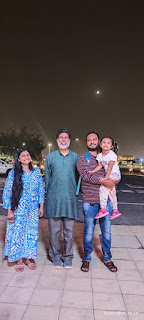
Tailpiece This family day, I am with the family of my former student, Alan. Eight years ago, I had the opportunity to bind them together as a minister of the Church, and today, I am in Doha with them on their anniversary.  We celebrate at Nehdi Mandi, Wakra, and I remind them that it happens to be also the international day of families, and also that I had remembered them at the Eucharistic Table. Though far from being a green family, they are happy with their mutual gift to the world - Eva! And may they remain so for the rest of their years, pray, long years! 

*https://www.vatican.va/content/john-paul-ii/en/letters/1994/documents/hf_jp-ii_let_02021994_families.html